Showing posts with label empathy. Show all posts

Saturday, September 1, 2018

Echoes of Sophocles in the Death of a Senator

Immediately after Senator John McCain passed away last Saturday, August 25, controversy swirled. It came from the current commander-in-chief.  The President's advisers counseled him to issue a statement praising McCain as a "hero," but the President instead released a simple Tweet expressing his rather indifferent "sympathies." Another article from the Washington Post captured the significance of the move well in its title, "Trump's not-so-subtle denigration of a dead man." The two men, both Americans, both officials elected to protect and defend the Constitution of the United States, ostensibly were on the same side. Animosity between them, however, prevailed.

John Sidney McCain III (1936 - 2018)
Some of the reasons for their animosity are complex, perhaps even principled.  As former Senate colleague and Vice President Joe Biden remarked at a memorial service in McCain's home state of Arizona, "John could not stand the abuse of power wherever he saw it, in whatever form, in whatever country." Some of their reasons were petty.  President Trump disliked McCain for the latter's pointed critiques of his policy.  Even in the wake of McCain's death, the President ordered the American flag raised again to full mast less than 24-hours after it was lowered to half-staff in honor of the fallen warrior and statesman.  Only after public pressure did the President reverse his decision and say that the flag would remain at half-staff until McCain was laid to rest tomorrow, a week after the flag controversy began.

What is telling about the remarks from Biden is that he represents the Democratic Party, but McCain, the Republican Party. On the surface, they should have been at odds, not two fellow Republicans.  Moreover, it should have been the current President of his own party, not the former Vice President of the opposition party, who could sincerely insist, as Biden did, "John was a hero. His character, courage, honor, and integrity. His optimism. That’s what made John special. It made John a giant among all of us."

The affirmation of McCain by Biden in my ear echoed similar comments by Odysseus in Sophocles' Ajax:  "My enemy, it's true.  But he was noble. / ... His greatness weighs more with me than my hate" (ll. 1355, 1357).

Ajax, placing his sword in the ground.
There are, of course, major differences between the circumstances surrounding McCain's and Ajax's deaths, but the point of contact that I wish to highlight is the various characters' responses to it.

In Sophocles' play, Ajax suffers what he believes is dishonor and shame after being passed over in the privilege to receive Achilles' armor, which went to Odysseus instead. This was a mark of Odysseus' worthiness in the eyes of the Greek leaders to carry on the tradition of their finest warrior.  Ajax goes into a rage and plots to kill the leaders of the Greek army because of the slight, which he was prevented from doing only by the bewitching intervention of Athena. After Ajax dies from a self-inflicted wound, first Menelaus and then Agamemnon step forward to prevent his proper burial.  Such a move -- that is, being denied burial -- was in that culture a deep disgrace within the community and carried unsettling consequences for the departed in the afterlife, such as it existed.

The third of the Greek leaders whom Ajax had attempted to destroy was Odysseus, who nevertheless appears and counsels Agamemnon to relent.  Agamemnon is perplexed. In Greek culture, to rejoice over an enemy's death is deemed fitting, and to put an enemy to public shame is part of winning honor for oneself. At the outset of the play, Athena invites Odysseus into a little playful ridicule of the beguiled Ajax and then matter-of-factly asks him rhetorically, "But to laugh at your enemies-- / What sweeter laugher can there be than that?" (ll. 78-79).  So when later Agamemnon asks Odysseus, "But now he is dead, / Shouldn't you rightly trample on his corpse?" (ll. 1347-1348), Agamemnon's rhetorical question has added cultural and moral force.

The unfolding of events and dialogue in Sophocles' drama raises questions about, among other things, the recognition of nobility even among one's enemies.  Another question, similar to that which the final books of Homer's Iliad give shape, is what honors are owed the dead.  Achilles is checked in his hate of Hector, whom he has killed, by Priam's passionate, paternal intercession.  A suggestion of that epic poem's narrative arc is that even by Greek standards such violence as depicted in it was excessive.  Priam persuades Achilles through appeal to their shared humanity, fellow feeling, and the imaginative empathy that comes from thinking through a situation with exchanged eyes.

In the Ajax, something similar seems to be at work within Odysseus.  Early on, in what is a programmatic speech for the rest of the drama, Odysseus replies to Athena, who wishes for Odysseus to ridicule and gloat over the out-of-mind Ajax because of his reversal of fortune:
… Yet I pity
His wretchedness, though he is my enemy,

For the terrible yoke of blindness that is on him.
I think of him, but also of myself;
For I see the true state of all of us that live—
We are dim shapes, no more, and weightless shadows. (Ajax, ll. 121-26; my emphasis)
Odysseus feels that way about Ajax, conflicted, while Ajax lived and his life was threatened by him.  And so when Ajax has died, his pity takes a different form, as he explains to Agamemnon: "I hated him while it was fair to hate" (l. 1346).  Odysseus courageously implores his commander-in-chief,
Don't cast out this brave man's body
Unburied; don't in the gods' name be so hard.
Vindictiveness should not so govern you
As to make you trample on the right. (ll. 1332-1335)
Agamemnon worries that if he consents to honor Ajax with a proper burial he will look weak: "You'll make me look a coward in this transaction" (l. 1362).  Odysseus counters, "Generous, though, as all the Greeks will say. ... However you do it, you will deserve praise" (ll. 1363, 1369).

In the end, Agamemnon relents, but he still does not regard the fallen Ajax as a hero.  He still detests him and thinks only of his own honor, not that of Ajax.  In contrast, Odysseus can say, as noted above, "But he was noble" (l. 1355).

More than two thousand years later, it remains hard for leaders to look past themselves, past their animosities, and say with a sense of shared humanity, "Yet I pity his wretchedness, though he is my enemy." It remains hard to say, "I think of him, but I think also of myself, for I see the true state of all of us that live." It is still a challenge, even after former opponents and critics have died, to confess, "But he was noble." And it is not just leaders in exceptional circumstances who struggle with this.

Friday, September 25, 2015

Psychological Complexity in James's "The Aspern Papers"

I have long admired Henry James.  He was a college discovery.  I should say, rather, that he was an author whom I discovered while studying in university through a course assignment.  To some, such an assignment would have seemed onerous.  To me, it was felicitous.

Monday, May 11, 2015

Emotions & Morals, pt. 4: Adam Smith -- British Sense Theorists

Adam Smith is the last of the three major British moral sense theorists that we will examine in this series.  Smith was a friend of David Hume's, whom we discussed last time. Smith, much like Hume before him, saw himself engaged in moral science, the empirical description of how we as humans think about morals, how we make moral judgments, and how we assess the motivations, words, and actions of others.

Sunday, May 10, 2015

Emotions & Morals, pt. 3: David Hume -- British Sense Theorists

Francis Hutcheson importantly influenced fellow Scot David Hume, although Hume would argue against Hutcheson's particular view of benevolent affections (see prior post on Hutcheson here). Before analyzing closely some places where Hume's moral theory differs from that of his mentor Hutcheson, what, first, is the main area of agreement between them?

Friday, May 8, 2015

Emotions & Morals, pt. 1: Introduction -- British Sense Theorists

Have you ever wondered about the interaction between emotion and reason in forming moral views?  The cartoon below reflects interactions that I am sure we have all had, just as it also reflects a presumed dichotomy between fact and value, reason and emotion, that I have in many ways come to question. Still, it humorously points to the "fact" that reason is not always the only or the strongest influence on belief.

What about our moral beliefs, those pertaining to what we consider virtuous? Our daily conversations with others presuppose the need to provide justification for our beliefs. But what exactly counts as justification?

Indeed, what will legitimately serve as adequate grounds for our beliefs and actions is often disputed. Many times the contention revolves around what one party thinks is based on reason (i.e., conclusions reached by deduction or induction from concepts or empirical data) rather than emotion (i.e., internal sentiments, impulses, or feelings). And the other party might take sentiment to be quite adequate grounding, or at least part of it.

Tuesday, December 16, 2014

Poetry Today -- Some Thoughts

Recently I posted about medieval Chinese poetry, and I attempted to produce a poem of my own in one particular mode. However successful that endeavor was, it did start me to think about the state of poetry today.  In former times, poetry was read, recited, memorized, and exchanged.  It formed communal bonds, and it shaped society's worldviews and mores.  What is the state of poetry today?

Friday, October 31, 2014

Dante and Virgil: Learning from Others

To what degree can, or should, we learn from others different from ourselves? Particularly, how much can, or should, we learn about the path that we believe we must take from those who have chosen a different path?  This is a question as much about social relations and integrated thinking as it is about personal identity and self-discovery.

In Dante’s Inferno, Canto 1, Dante affirms that Virgil is his guide and teacher:

'You are my teacher and my author. 
You are the one from whom alone I took 
the noble style that has brought me honor. 
     (Inferno, 1.85-87; all references to Hollander trans.)

Here Dante refers to his prior poetic writings.  The implication is that Dante will also inform the current poetic enterprise with its subject matter. This is somewhat curious because also in the first canto we read that Virgil will not be Dante’s guide in the last stage of his journey upward to “His city” (l. 126).  The reason Virgil gives is that he is not worthy to guide Dante through paradiso to God, and the reason for his unworthiness is that Virgil himself strayed from the righteous path that Dante seeks to find:

'Should you desire to ascend to these, 
 you'll find a soul more fit to lead than I: 
 I'll leave you in her care when I depart. 
 'For the Emperor who has His seat on high 
 wills not, because I was a rebel to His law, 
 that I should make my way into His city. 
(Inferno, 1.121-126)

Despite Virgil’s spiritual state as a reprobate, as a rebel, as someone in other words who did not bend his will to God and who did not follow his righteous path, Virgil himself asserts that he is, however, fit to instruct and lead Dante through hell:

'Therefore, for your sake, I think it wise 
you follow me: I will be your guide 
(Inferno, 1.112-13)

Yes, we learn later in the Inferno that God had commissioned Virgil for this task.  In Inferno canto 2, we learn that this commission came through three heavenly ladies, but the point is that Virgil bears God’s authority when interacting with inhabitants of hell at various stages. 

My own reflections about my current identity development and self-discovery prompted these thoughts as I recently read Dante’s Inferno:  Virgil the pagan poet is authoritatively permitted, commissioned, to instruct Dante in his pursuit of light and righteousness.  Virgil may have been opposite to God but yet still may be a reliable guide -- in fact, a heaven-sent guide.  The pagan poet acts as pedagogue to the spiritual pilgrim. 

So again, the particular related struggle or question:  What and how can I learn about the path I must take from those who have chosen a different path?

This question strikes me as one of universal concern.  It assumes that we are all wrestling with the question of self, of our own respective identities, while at the same time locating ourselves in connection with (and distinction from) others, even others not of our “circle.”  Or we are negotiating ever expanding circles.  What is the proper relationship?  How close is too close?  Will I be influenced overly by their decisions rather than finding the proper balance between their ideas and my own?

Dante and Virgil, rendered by Botticelli
In my own life, I am currently near that midpoint, just as Dante was, the nel mezzo.  I am trying to ask from familiar and unfamiliar points of view big questions about God (nature, revealed truth), about God’s relations to humans (of what sort is it?), about human nature and the relation of the mind to both the brain (is there really anything that is a “mind”? Is it somehow distinct from the physical brain and chemical reactions?), and about the nature of morality in general and its relationship to God in particular (what is the precise connection? Is there a necessary foundation?).

In asking these and other questions, I find that I must necessarily do at least two things. (1) I must reevaluate what I believe by taking stock first of what I actually think (perhaps with greater precision than I hitherto have or have in some while, a valuable enterprise itself).  And (2) I must weigh that review against the ideas of others who have followed paths that I have not before trodden. Is it better? If not, why is it worse? What to pursue, what to avoid?  What to retain, what to reject?

Of late in my own life have been wondering how modern neuroscientific conceptions of the brain bear on questions of human sinfulness, ethical behavior and responsibility, and the need for salvation at all. Physiologically, what goes into cognition and moral judgment?  What implications might there be, if any, on various religious belief if philosophical and psychological theories about the modular mind and the lack of anything like a singular “self” prove to be true?  What of the question of chemical explanations for innate ideas of transcendence and the divine?

The upshot, and the connection between Dante’s poem and my own external context (and perhaps one of universal concern) is the extent to which I can learn from guides or teachers not within my circle and yet continue to follow the righteous, God-approved path.  Dante altered his path, and in so doing also altered his conception of himself -- at least expanding it.  For Dante in the dark wood of the mid point of his life, it was not a matter of interacting with things like ancient Chinese thought or neuroscience.  But on his path he was surprised to find Virgil as his guide through the Inferno, a guide limited to a portion of the journey, but reliable nevertheless and divinely commissioned however different from Dante he may have been.  But Dante the poet was also relieved and encouraged to find his guide to be Virgil, the Roman poet par excellence.  And it may be that certain connections are more important than differences to initiate our exploration of both.

How may I learn from Virgil without befalling his fate?  That is perhaps one of Dante’s questions, and it is, metaphorically, mine and, in one way or another, also all of ours.

Tuesday, October 28, 2014

The Economy and Pursuit of Happiness

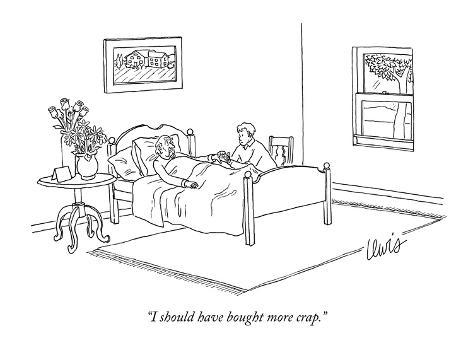
In an earlier post, I discussed the economics of empathy.  That post pertained to both empathy and thanksgiving.  I recently ran across this New Yorker cartoon, which summarizes much positive psychological research into acquiring happiness.


Of course, this cartoon is funny because it is ironic.  If you find it humorous, you know that it is not true:  A man lying on his deathbed and reflecting about meaning in his life does not say, "I should have bought more crap."

"Crap" of course provides an assessment of the ultimate value of possessions.  It is telling, is it not, that we use the term "crap" as a synonym for "material possessions," and yet our culture remains nevertheless consumed with consuming material possessions.

But if happiness and meaning and satisfaction in life does not come by your buying more "crap," in what does it consist? Whence does it derive?

Cornell University psychologist Tom Gilovich, among others, suggests that, instead of consumption, instead of acquiring more things, we do better by acquiring more experiences.

Experiential "consumption" is more enduring.  People tend to talk about their experiences more than their possessions.  This in itself helps experiences to be means of social connections beyond the immediate circle of original participants.  You can extend your experiences, enjoying them again with others or finding empathy from others when they were not so good. Or you can even laugh (after enough time has elapsed) about how awful those experiences were!

Herein lies the enduring value of experiences:  you get to experience them, remember them, and to share them.

Your experiences affect and constitute who you are and who you are in relation to others.

Such sharing fosters empathy, both cognitive empathy ("I know what you mean!") and affective empathy ("I feel how you must have felt!").  It promotes bonding and greater awareness of shared humanity with expanding circles of solidarity. Tom Gilovich's research even suggests that people enjoy each other personally more when they talk about their experiences more than when they talk about their possessions.  So there may be cultivated not only cognitive and affective empathy but also deeper relational affection itself.

Sharing by definition is a form of generosity.  Benevolence is both pro-social and its own reward.

The implication is that, if you are going to try to "buy happiness," purchase an experience, not "more crap."

Friday, September 19, 2014

Emotionally Invested in the Union

Yesterday Scotland voted on the question of whether it would remain in the United Kingdom or secede to become an independent nation.  Today the results showed that the "No" vote -- no on separating -- carried by a margin of approximately 55% No to 45% yes.  Historic, yes this vote was. But I am writing because of the mystery surrounding how personally I took it.

It was personal in a way that I cannot fully explain.  I was pleased with the outcome.  I wished for Scotland to remain in the union.  But why?

I have Scottish heritage, but I also have English and Irish and French.  I am an American citizen, and so I had no say in the matter regardless.  I do not have living relatives who live in Scotland or England or Northern Ireland and therefore who would be directly affected.  So why was I so anxious leading up to the vote?  And why was I so pleased when I woke this morning early and read before 5 am that Scotland had voted to remain in the union?

I have reflected on my emotional investment for some time, at least in the weeks leading up to yesterday's vote.  The key question was why.

I have long appreciated the Scottish contribution to much of enduring influence.  There is, in no certain order, the valuable legacy of Francis Hutcheson, David Hume, and Adam Smith to moral philosophy.  There is Smith's broader contribution to global economics.  There is Thomas Reid's common sense realism, which affected so much of certain strands of western epistemology and even Christianity (particularly among Presbyterianism on both sides of the Atlantic).  There is golf.  There are tartans.  There is the brogue.  There is Sean Connery.  There are the picturesque Highlands, poets like Robert Burns, haggis, and contemporary philosophers like Alasdair MacIntyre.  And there is, of course, single malt Scotch, smokey, peaty pleasure in a wee dram -- or more than just a wee dram.

But this appreciation, maybe even nostalgia, could equally tend toward favoring Scottish independence.  Why then did I favor union?

It is hard to say.  I agree with Alan Greenspan that a vote for independence would have "surprisingly negative economic consequences."  The unknown -- unknown challenges, unknown blowback -- is a greater risk than the certainty of sovereignty.  Symbolically, at a time when Europe is struggling to preserve its own political/military experiment which is the European Union (and let us not forget that the EU is ultimately an economic union designed to prevent military conflict among countries where there has been so much of it through the centuries), it would have been antithetical to the rhetoric coming out of Brussels to preserve union if a member country, Great Britain, experienced a secession.  (Yes, Britain is not part of the monetary union, but it is part of the political union.)

So maybe it is loving the idea of Scotland and its distinctiveness but also wanting the best for Scotland and believing that independence would have brought hardship beyond the naive aspirations of certain older generations (mostly in Glasgow) and the excitable youth.  Maybe there is some desire to see Britain Great, and realizing that England and Scotland would likely be less if they were not connected beyond sharing a land mass.  David Cameron had a fair point, namely, that parties in power will come and go, but a vote to separate would be irreversible at this point.  And hasty actions of great consequence, especially when they involve such far-reaching effects as reconstructing (or doing it from scratch) a national security apparatus, choosing and implementing a currency, and looking beyond the potential immediate boon that North Sea oil assets would provide.  What happens generations from now?

Maybe it is realizing the something great would be lost if there were Scottish independence that made me want to preserve that greatness by preserving the union.

It remains difficult to say.  And maybe it will always be inexplicable.  In any event, tonight I raise my wee dram to 300 more years of united greatness for Britain.

Thursday, March 6, 2014

DFW and the Fundamental Attribution Error

A couple of weeks ago I decided to revisit David Foster Wallace's famous Kenyon College commencement address from May 21, 2005.  It was subsequently revised and published as "This Is Water."  (The audio and various text editions, including a transcription of the original speech and one cleaned up, are easily available on the web.)  Among many things that struck me upon both rereading and listening to the address, one thing jumped out in particular.  And I think it is one key reason that DFW's address went viral back then and is still discussed now.

Thursday, November 14, 2013

The Economics of Empathy (and Thanksgiving)

In the United States, the Thanksgiving holiday is two weeks away.  For those who have experienced it, Thanksgiving can be a wonderful holiday.  Everyone across ethnic, political, and religious lines can equally participate.  Indeed, that was the purpose in President Lincoln's proclaiming it a national holiday in 1863, when the country was torn apart by Civil War.

In more recent times, Thanksgiving seems to be part of a double holiday, or at least a double tradition. Thanksgiving Thursday is followed by Black Friday, so named because it is the day when, traditionally, retail sales increase to the point that merchants begin to turn a profit for the year. That is, their books move into the black. The observance of Thanksgiving is completed by consumption. Let us not forget that the purpose is to pause and render gratitude for the blessings of one's life. From the outside, however, it could seem as though Americans are most thankful that they can hit stores at ridiculously early hours on Friday morning to spend money on largely frivolous things.

That is a cynical view of Thanksgiving.  It is one to which I am susceptible.  But there are, I believe (or would like to think), more sober observers of this holiday and the use of money.  Some people volunteer at soup kitchens for the homeless or the working poor.  Others donate money to these shelters or similar aid organizations so that they can operate to serve the needy.  Many of these volunteers and donors tear up at the thought of a child's going hungry on any day, but especially on a festive day that celebrates not just bounty but, most basically, shared life together in community.  These people recognize that although they may be celebrating life, others are fighting for it.

These benefactors, just ordinary people, are thinking not primarily of their own happiness:  watching football, enjoying tasty food, relaxing from daily labors, basking in the company of treasured friends and family.  They are trying to share the simple happiness that comes from food with others who lack it.

In a 10-minute TED talk given two years ago, Harvard professor Michael Norton takes up the question "how to buy happiness."  His research, both in the United States and abroad, confirms, perhaps unsurprisingly but still emphatically, that people report increased happiness when they spend money on others, not on themselves.  The amount of money spent does not matter.  What matters is the target.


The short video is worth watching for the creative ways in which Norton and his colleagues test this hypothesis.  Some tests are even humorous.  And the results were not solely about personal happiness but, more generally, about the positive effects that accrue within groups who are charitable, empathetic, or just concerned about others.  There appears to be a multiplier effect that arises from demonstrating empathy:  the reward is greater than the investment when one invests in other people.

My sense is that this will also increase one's general sense of thanksgiving.  Spending money on others will foster an increased feeling of gratitude for one's current lot in life.  A huge part of this is through deepening personal connections.  Sometimes it comes from making the effort to establish them.

I am reminded of the Thanksgiving scene from the movie The Blind Side.  The video below does not adequately depict the scramble that the Tuohy family members have on Thanksgiving for the television where the day's American football games are being shown.  Thanksgiving in their world is about private consumption:  family members eating plates separately, watching multiple screens, and not really communing with one another.  They are alone together.  Their guest is alone by himself.  This is where the clip begins.


Mrs. Tuohy discerns the difference, and she does something about it.  It was not enough, she realizes, to invite Michael into her home for the holiday because he had nowhere else to go.  She, and the rest of her family members, needed to make him part of their family.  And this meant that Mrs. Tuohy's family needed to act like one itself.  Disconnected viewing of television around a large room needed to give way to the connected holding of hands around the Thanksgiving table.

After all, what would have been the point of reproducing in their home the isolation that Michael already felt without one?

This is the economics of empathy:  greater rewards and personal happiness accrue when we invest in -- that is, spend time or money on -- other people.  First comes empathy, then happiness, because empathy establishes personal connection.  By it we embrace our common humanity.  This is the purpose.  But the effect is that by it also both giver and receiver become truly thankful.

Tuesday, September 24, 2013

The Ethical Imagination of Art

Why, when we see acts of apparent selflessness, do we often swell with emotion?

Why, to put an even finer point on this, when we observe even fictional gestures of sincere compassion, do we pause, tear up, reach for a tissue or a nearby loved one, and become seized with something that transcends admiration -- something that feels like melting?

Art, in its various forms, uniquely taps into the human imagination, grips our emotions, and, if we listen, instructs.  Take, for example, the following short video clip, which of late, and deservedly, has been making the social media rounds.

(The YouTube link for the video is here.
The brief article about the video from Gawker is here.)


Sunday, September 22, 2013

Empathy in Kafka and in Life


Franz Kafka’s fantastic stories of “The Metamorphosis” and “A Country Doctor” present a narrative world that not only assumes the reader’s suspension of disbelief but also requires it.  The stories require it in order to generate in readers appropriate empathy with the characters. These two acts -- (1) the willingness to engage in the narrative world and (2) the resulting emotional engagement with the characters in their relational contexts -- enable literature to foster empathy with others in a way that transcends the constraints imposed by relational life outside of literature. “The Metamorphosis” in particular facilitates in the reader a transformation of understanding by narrating Gregor Samsa’s transformation of being.

Wednesday, September 11, 2013

The Fiction of Sexual Violence, pt. 2: Faulkner


In the first part of this series on the fiction of sexual violence, I briefly explained the twin aspects of "fiction" according to which I will explore this theme.  I began with Toni Morrison's Beloved and a reading of the effects of Ella's experience as a sex slave (quite literally as a slave in the Antebellum South).  And I suggested that we see in her trauma how sexual violence both disables a person's capacity for love (both loving and being loved) and dehumanizes the person in the process.  In Faulkner’s Light in August, the sexual violence between Joe Christmas and Joanna Burden is different.

Saturday, August 31, 2013

Moral Ambiguities in Prévost, pt. 2: Autonomy and Empathy

In my previous post on moral ambiguities in Prévost's Manon Lescaut, I observed how, even when characters and stories are explicitly said to be moral examples, the precise nature of the moral instruction may not be clear.  In particular, I asked of the ethical lesson reflected in the Chevalier des Grieux's interactions with others, "Is one to avoid (being duped into) compromising one’s moral judgment because of compassion, or, positively, to pity a libertine and lighten punishment?  Is one to recognize that pity is a virtue but that manipulating it for self-gain and moral license, as Des Grieux does, is a vice?"  In this post, I simply want to mention a couple of ways in which these questions are as alive for us today as they were for Abbé Prévost in the 1700s:  the relationship between autonomy and empathy in moral evaluation.

Wednesday, August 28, 2013

Moral Ambiguities in Prévost, pt. 1: Examples


When we say that someone is a moral example, what exactly do we mean?  How skilled are we at discerning the supposed moral virtue to be emulated?  These are questions that I was prompted to consider recently while reading some European fiction and that I think are of abiding relevance. 

In the Foreward to his delightful novel Manon Lescaut (rev. 1753; orig. 1731), Abbé Prévost describes “the subject of the picture I will present” as “an ambiguous character, a mixture of virtues and vices, a perpetual contrast between good impulses and bad actions.”  Prévost envisions the narrative “as an aid to moral instruction.” Specifically, one “will see, in Des Grieux’s conduct, a terrible example of the power of passions…” (Manon Lescaut, 3, although Prévost’s sincerity here is questionable given the text’s history of censorship).  What remains narratively ambiguous is the nature, or content, of the moral instruction supposedly intended.  Is it traditional or unusual?  Without resolving that question, it seems to me that in seeking empathy from other characters Des Grieux highlights how feelings influence, and usually soften, moral judgment.

Thursday, August 22, 2013

Narcissism on the Rise: Notable and Quotable


From D. G. Myers, Social Psychology (11th ed.; New York:  McGraw-Hill, 2012), 54.

After tracking self-importance across the past several decades, psychologist Jean Twenge (2006; Twenge and others, 2008) reports that today’s young generation – Generation Me, she calls it -- express more narcissism (by agreeing with statements such as “If I ruled the world, it would be a better place” or “I think I am a special person”).  Narcissism scores rose over time on college campuses from Alabama to Maryland to California (Stewart & Bernhardt, 2010; Twenge & Foster, 2008, 2010).  Narcissism correlates with materialism, the desire to be famous, inflated expectations, fewer committed relationships and more “hooking up,” more gambling, and more cheating, all of which have also risen as narcissism has increased.  Narcissism is also linked to a lack of empathy -- the ability to take someone else’s perspective and be concerned about their [sic] problems -- and empathy has dropped precipitously among college students (Konrath & others, 2011).  The researchers speculate that today’s generation may be so wrapped up in online interaction that their in-person interaction skills have atrophied.  Or, they say, empathy might have declined because young people today are “feeling too busy on their paths to success,” single-mindedly concentrating on their own achievement because the world is now so competitive.  Yet, ironically, those high in narcissism and low in empathy are less -- not more – successful in the long run, making lower grades in college and performing poorly at work (Judge & others, 2006; Robins & Beer, 2001).

But what about a different version of that last ironic phenomenon (high narcissists with low empathy who are lower performing academically and professionally but nevertheless are long-term successful)?  That phenomenon which is familiar to many of us in our everyday experience has a technical explanation attached to it:  promote the jerk and make him someone else’s problem.

There actually is a social scientific explanation more nuanced than the (accurate) one that I just gave.  It is that “even if overconfidence produces subpar results, others still perceive it positively.” Therefore, a jerk, sub-par performer is elevated in an attempt to pair appropriately his status with his perceived attitude.  The thought might be something like, “Well, I find him gratingly obnoxious, but he must be the type of person who gets ahead, because he displays similar traits of authority, power, and exceptionality.” 

We may not be able to control the behavior of narcissistic jerks, but we can be more mindful not to perceive them as better than they are.  And we can take more self-conscious care to check our first psychological impression and not put them on a pedestal.

Of course, sometimes narcissists are at the top simply because they own the place.

Monday, March 25, 2013

Darwin and Nietzsche on Genealogy

Taking a genealogical approach to an idea -- what is its lineage, family tree, or antecedent chain of births? -- is not new.  Jean-Jacques Rousseau had arguably taken a similar approach to moral degradation and inauthentic living in his "Discourse on the Origin of Inequality" (1754).  (See, e.g., two prior notes on this, here and here.)  It does seem, however, that genealogy more explicitly comes into its own as a method of inquiry in the nineteenth century.  Sigmund Freud himself later will follow much the same path in Civilization and Its Discontents (1930).  When one reads Freud's exploring the genealogical history of human unhappiness with civilization, which he explains by tracing the evolution of guilt in the development of the super-ego, one detects not only the influence of Rousseau's incipient genealogical explorations, but also the more mature and distinct projects of nineteenth-century luminaries Charles Darwin and Friedrich Nietzsche.

Friday, March 8, 2013

Rousseau and Flaubert on History

What is the role of historical progress, or its effects, in the thinking of two Frenchmen, Jean-Jacques Rousseau (1712-1778) and Gustave Flaubert (1821-1880)?  In my last post, I compared Rousseau to Immanuel Kant (1724-1804) on the subject of what Enlightenment is and has done.  In this post, I want to build on that by focusing more specifically on the question of history as it marched from the period of Enlightenment further into the period of modernity.  And I want to explore this within the French borders.  Kant and Rousseau were contemporaries but not countrymen.  The opposite is true of Rousseau and Flaubert, and it may be beneficial to glimpse how successive generations of French writers saw things unfolding.  Before turning to that, however, a refresher on the European context may be helpful.

Thursday, July 19, 2012

Making Sense of Wilson, pt. 2: Sympathy

In part 1 of this series of my reflections on James Q. Wilson's book The Moral Sense, I summarized the book's main aims and shared a few of the most salient points that I found of conceptual and practical value.  In this post, I begin to tackle the book's second section, which examines four key moral sentiments:  sympathy, fairness, self-control, and duty.  Specifically I focus on sympathy.

As preparation for a review of moral senses such as sympathy, it may be helpful to recall what Prof. Wilson is and is not doing by exploring these sentiments:
I am not trying to discover "facts" that will prove "values"; I am endeavoring to uncover the evolutionary, developmental, and cultural origins of our moral habits and our moral sense. But in discovering these origins, I suspect that we will encounter uniformities; and by revealing uniformities, I think that we can better appreciate what is general, nonarbitrary, and emotionally compelling about human nature.  (26)
In the chapters on the four moral sentiments, Prof. Wilson does just this.  He weaves together the evolutionary, developmental, and cultural origins of these respective moral habits and senses.  In doing so, I find his descriptive observations -- which are helpful in their own right as an organizing heuristic for thinking about moral matters -- to pull me toward practical considerations and action.

I offered a few remarks on sympathy, "the human capacity for being affected by the feelings and experiences of others" (30), in the earlier post.  It helped to exemplify the basic approach to the subject that Prof. Wilson takes.  Sympathy, like the other sentiments, functions in human life as both a motivation for moral action and a standard for it.  A few other brief notes are worth mentioning.

In all of his chapters on the sentiments, if to varying extents, Mr. Wilson explores the relevance of evolutionary biology on the moral sense in view.  The theory of inclusive fitness, advanced by William Hamilton after Charles Darwin, fills out the latter's theory of a species' successful self-propagation over time:  "An individual is reproductively successful to the extent that his genes occur in the next generation, and he can assure that occurrence not only by reproducing himself but also by assisting in the reproduction of individuals who have his genes" (41).

Professor Wilson admits that this theory might explain why we humans sacrifice ourselves for our kin, but it does not go very far in explaining why we humans are willing to sacrifice ourselves for our grandmother, who is past childbearing age and cannot deposit genes to future generations.  It also does not explain why we may rush into a burning building to save a dog or adopted children, with whom we have no genetic similarity (42).

Maybe the notion of reciprocal altruism can help:  "we engage in altruistic acts -- such as helping nonrelatives, caring for adopted children, or being affectionate toward pets -- in order to impress others with our dependability and hence to increase our opportunities to have profitable exchanges with these others" (43).  Mr. Wilson points out that as an explanation this utilitarian idea has truth elements to commend it, but a more basic motivation -- "a prior, dominant fact" (44) -- must be recognized.  We more basically value reciprocity in human relationships to which we are naturally drawn because we fear isolation and loneliness and we value human sociable companionship.  This human trait governs the theory of altruism, and it is at the heart of sympathy.

What can be said about evolution and sympathy, then, is this:  "If sympathy is widespread, it must have been adaptive, but what was selected for is a generalized trait that both encourages reproductive fitness and stimulates sympathetic behavior.  That trait, or adaptive mechanism, is attachment or affiliative behavior" (44; emphasis original).

We are naturally more sympathetic to those to whom we are most similar.  Humans naturally think of themselves first in terms of a small group (a nuclear family, an extended kinship, a local community, religious group), but we can imagine ourselves as part of a larger sphere and, with extra effort, behave sympathetically toward those who differ from us in race, religion, and culture.  Earlier, Prof. Wilson makes the keen insight that "life-styles" today is the nonjudgmental word for what used to be called "character," and I might broaden that to say "culture" (7).  This is a point that illumines the linguistic shift which has occurred in morality and permissible moral discourse, on the one hand, and that, on the other, contemporizes the tendency toward small group affiliation, toward those who live life as we do.

Two towering moral philosophers, both Scotsmen, in their own way identified sympathy as either the source of moral sentiments (Adam Smith) or at least as one of the two extremely powerful and basic sources along with utility (David Hume).  Both men viewed moral philosophy as inextricably linked to the study of human nature.  The place of sympathy in the thought of other philosophers could be mentioned, but the central place of it in Smith's and Hume's writings should prompt us to reflect more than we typically do -- or I have done -- on what it is, how it is manifested, and how it might be cultivated.

Sympathy can lead to benevolent feelings and actions, Mr. Wilson notes, but we should not limit sympathy to the rosier side of life:
Sympathy is often expressed by phrases that convey not tenderness or concern, but anger and vengeance.  If we see an abominable act -- say a man laughing while torturing an innocent baby -- our first reaction is not likely to be an expression of sympathy for the child but rage at its tormenter; and this will be true even if it is not our child.  Sympathy is often wrongly portrayed as entirely a tender sentiment:  sympathetic people are sometimes described as soft, warm, or weepy.  They often are; but they are much more than that, and some of the most sympathetic people have no trace of cuddliness in their temperament.  Even so staunch a utilitarian as John Stuart Mill recognized this:  "It is natural to resent and to repel or to retaliate any harm done or attempted against ourselves or against those with whom we sympathize." (40)
If we do not limit sympathy to the soft and warm side of life, then we should perhaps also be prepared to view anger and vengeance as legitimate moral responses that stem from not just a sense of justice but also of sympathy.

In this way, we may also have stumbled upon an important observation:  moral senses such as sympathy and justice are connected.  We may not be able to say (yet) with someone like Adam Smith that sympathy is the primary cause of moral sensibility.  But we recognize that there is interplay between the moral senses.

Moreover, if there is any truth to the commonplace that men and women are different (a truism to which some do in fact object), and if on the whole it is the case that women naturally display the tender and sensitive side of sympathy more than do men, then men would do well to remind themselves that such sympathy may be a manifestation of moral sense.  And it may be a commendable moral expression just as much as the stereotypical male tendency to display the more violent and vengeful side of sympathy.

If they are so tempted, men, in other words, should not diminish women's proclivity to soft sympathy.  Women, likewise, should not diminish men's proclivity to hard sympathy.  Both may be appropriate, admirable actions stemming from a developed moral sense.  If morality is valued, then the various expressions of the moral senses should also be valued.

To be sure, members of each sex can and often do display the moral trait that I have associated as more typical of the other.  The point is not gender stereotypes per se but better mutual appreciation among the sexes.  Professor Wilson's discussion of sympathy, which recognizes its pluriformity, provides men and women enhanced grounds for doing what they already know that they ought to do:  live patiently in an understanding way with one another.  Sympathy has come full circle.