Is forgiveness, for Dante, the most radical form of freedom and the fullest expression of love? I believe that it is, although not precisely as some readers of Dante sometimes argue. I have in mind in particular the overstatement of forgiveness in terms of the existentialist reading that I perceive permeates some contemporary readings of the Commedia.
Showing posts with label friendship. Show all posts
Showing posts with label friendship. Show all posts
Thursday, May 21, 2015


Tuesday, October 28, 2014
The Economy and Pursuit of Happiness
In an earlier post, I discussed the economics of empathy. That post pertained to both empathy and thanksgiving. I recently ran across this New Yorker cartoon, which summarizes much positive psychological research into acquiring happiness.

Of course, this cartoon is funny because it is ironic. If you find it humorous, you know that it is not true: A man lying on his deathbed and reflecting about meaning in his life does not say, "I should have bought more crap."
"Crap" of course provides an assessment of the ultimate value of possessions. It is telling, is it not, that we use the term "crap" as a synonym for "material possessions," and yet our culture remains nevertheless consumed with consuming material possessions.
But if happiness and meaning and satisfaction in life does not come by your buying more "crap," in what does it consist? Whence does it derive?
Cornell University psychologist Tom Gilovich, among others, suggests that, instead of consumption, instead of acquiring more things, we do better by acquiring more experiences.
Experiential "consumption" is more enduring. People tend to talk about their experiences more than their possessions. This in itself helps experiences to be means of social connections beyond the immediate circle of original participants. You can extend your experiences, enjoying them again with others or finding empathy from others when they were not so good. Or you can even laugh (after enough time has elapsed) about how awful those experiences were!
Herein lies the enduring value of experiences: you get to experience them, remember them, and to share them.
Your experiences affect and constitute who you are and who you are in relation to others.
Such sharing fosters empathy, both cognitive empathy ("I know what you mean!") and affective empathy ("I feel how you must have felt!"). It promotes bonding and greater awareness of shared humanity with expanding circles of solidarity. Tom Gilovich's research even suggests that people enjoy each other personally more when they talk about their experiences more than when they talk about their possessions. So there may be cultivated not only cognitive and affective empathy but also deeper relational affection itself.
Sharing by definition is a form of generosity. Benevolence is both pro-social and its own reward.
The implication is that, if you are going to try to "buy happiness," purchase an experience, not "more crap."
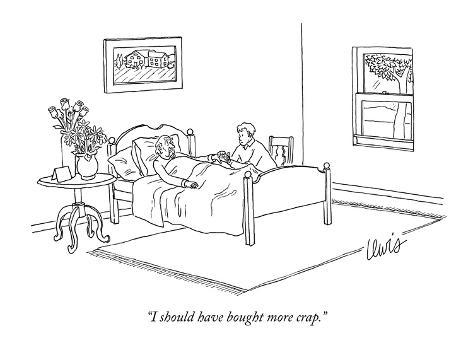
Of course, this cartoon is funny because it is ironic. If you find it humorous, you know that it is not true: A man lying on his deathbed and reflecting about meaning in his life does not say, "I should have bought more crap."
"Crap" of course provides an assessment of the ultimate value of possessions. It is telling, is it not, that we use the term "crap" as a synonym for "material possessions," and yet our culture remains nevertheless consumed with consuming material possessions.
But if happiness and meaning and satisfaction in life does not come by your buying more "crap," in what does it consist? Whence does it derive?
Cornell University psychologist Tom Gilovich, among others, suggests that, instead of consumption, instead of acquiring more things, we do better by acquiring more experiences.
Experiential "consumption" is more enduring. People tend to talk about their experiences more than their possessions. This in itself helps experiences to be means of social connections beyond the immediate circle of original participants. You can extend your experiences, enjoying them again with others or finding empathy from others when they were not so good. Or you can even laugh (after enough time has elapsed) about how awful those experiences were!
Herein lies the enduring value of experiences: you get to experience them, remember them, and to share them.
Your experiences affect and constitute who you are and who you are in relation to others.
Such sharing fosters empathy, both cognitive empathy ("I know what you mean!") and affective empathy ("I feel how you must have felt!"). It promotes bonding and greater awareness of shared humanity with expanding circles of solidarity. Tom Gilovich's research even suggests that people enjoy each other personally more when they talk about their experiences more than when they talk about their possessions. So there may be cultivated not only cognitive and affective empathy but also deeper relational affection itself.
Sharing by definition is a form of generosity. Benevolence is both pro-social and its own reward.
The implication is that, if you are going to try to "buy happiness," purchase an experience, not "more crap."
Thursday, March 20, 2014
The Transformation of Sir Gawain’s Greenness
As a narrative poem Sir
Gawain and the Green Knight imaginatively creates moral suspense -- real suspense
around the strength of bravery, integrity, and virtue. It does so for a community and individuals who
might often seem exemplars of honor:
King Arthur and the knights and ladies of his Round Table. I find this of interest now years after I
first read works like Malory’s Le Morte d’Arthur,
White’s The Once and Future King, and
Tennyson’s Idylls of the King,
because of the personal and communal transformation that occurs in Sir Gawain.
When I was a lad, I was most impressed by the ability of
Arthur and Lancelot and Galahad and the like to defeat their enemies and
achieve success. Sure, I was aware of
some shortcomings in the characters. But
it was their larger-than-lifeness that then captured my readerly fancy. Now as an adult, I appreciate most the
depiction of Arthur and Gawain and the like as simultaneously virtuous and
flawed characters who, nevertheless, press on with a sense of duty and fidelity
to themselves and to their communities. At
least this is my reaction after recently reading Merwin’s translation of Sir Gawain and the Green Knight and after
reflecting on the symbolic transformation of the green belt at its ending.
Sunday, September 22, 2013
Empathy in Kafka and in Life
Franz Kafka’s fantastic stories of “The Metamorphosis” and “A Country Doctor” present a narrative world that not only assumes the reader’s suspension of disbelief but also requires it. The stories require it in order to generate in readers appropriate empathy with the characters. These two acts -- (1) the willingness to engage in the narrative world and (2) the resulting emotional engagement with the characters in their relational contexts -- enable literature to foster empathy with others in a way that transcends the constraints imposed by relational life outside of literature. “The Metamorphosis” in particular facilitates in the reader a transformation of understanding by narrating Gregor Samsa’s transformation of being.
Friday, September 20, 2013
"As It Used To Be": Children's Relationships in Vesaas
In Tarjei Vesaas’s The Ice Palace, the narrated interaction between eleven-year-olds Siss and Unn reveals the complex depths of the relationships that adolescents create. Through this innocent complexity, the Norwegian Vesaas illuminates an important dimension of what Arnold Weinstein calls the fiction of relationship. Vesaas does so, both in his fictional story about the friendship of two young girls and in the relationship that they actively construct.
Most basically, the connection between Siss and Unn reminds readers that children’s relationships are far from simple or rudimentary merely because the participants are not adults. Children, too, both long for relational intimacy and fashion their individual and social identity through their personal connections. It may be tempting for adults to look condescendingly on these early forays into friendship. Vesaas challenges us not to do so.
Most basically, the connection between Siss and Unn reminds readers that children’s relationships are far from simple or rudimentary merely because the participants are not adults. Children, too, both long for relational intimacy and fashion their individual and social identity through their personal connections. It may be tempting for adults to look condescendingly on these early forays into friendship. Vesaas challenges us not to do so.
Subscribe to:
Posts (Atom)