It is a peculiar sensation, this double-consciousness, this sense of always looking at one's self through the eyes of others, of measuring one's soul by the tape of a world that looks on in amused contempt and pity. One ever feels his twoness,--an American, a Negro; two souls, two thoughts, two unreconciled strivings; two warring ideals in one dark body, whose dogged strength alone keeps it from being torn asunder. (The Souls of Black Folk, p. 5)Du Bois has in mind a particular historical struggle. For Du Bois, this double-consciousness was the distinct self-perception, or group perception, of being on the one hand black and on the other hand Americans. If we can frame the tension that he identifies more generally, we might describe it as the unsettling difficulty of standing at the same time in more than one tradition.
Showing posts with label economics. Show all posts
Showing posts with label economics. Show all posts
Thursday, January 26, 2017
Du Bois, Double-Consciousness, and a Lingering Problem
W. E. B. Du Bois gave eloquent expression to a personal and socio-cultural tension at the beginning of the twentieth century that is simultaneously a reality that many of us have felt at one time or another, or perhaps even constantly. When Du Bois described the central problem of the new century for black Americans as being that of the color-line, he also articulated the challenge of negotiating different worlds, allegiances, and identities as that of double-consciousness:
Tuesday, October 28, 2014
The Economy and Pursuit of Happiness
In an earlier post, I discussed the economics of empathy. That post pertained to both empathy and thanksgiving. I recently ran across this New Yorker cartoon, which summarizes much positive psychological research into acquiring happiness.

Of course, this cartoon is funny because it is ironic. If you find it humorous, you know that it is not true: A man lying on his deathbed and reflecting about meaning in his life does not say, "I should have bought more crap."
"Crap" of course provides an assessment of the ultimate value of possessions. It is telling, is it not, that we use the term "crap" as a synonym for "material possessions," and yet our culture remains nevertheless consumed with consuming material possessions.
But if happiness and meaning and satisfaction in life does not come by your buying more "crap," in what does it consist? Whence does it derive?
Cornell University psychologist Tom Gilovich, among others, suggests that, instead of consumption, instead of acquiring more things, we do better by acquiring more experiences.
Experiential "consumption" is more enduring. People tend to talk about their experiences more than their possessions. This in itself helps experiences to be means of social connections beyond the immediate circle of original participants. You can extend your experiences, enjoying them again with others or finding empathy from others when they were not so good. Or you can even laugh (after enough time has elapsed) about how awful those experiences were!
Herein lies the enduring value of experiences: you get to experience them, remember them, and to share them.
Your experiences affect and constitute who you are and who you are in relation to others.
Such sharing fosters empathy, both cognitive empathy ("I know what you mean!") and affective empathy ("I feel how you must have felt!"). It promotes bonding and greater awareness of shared humanity with expanding circles of solidarity. Tom Gilovich's research even suggests that people enjoy each other personally more when they talk about their experiences more than when they talk about their possessions. So there may be cultivated not only cognitive and affective empathy but also deeper relational affection itself.
Sharing by definition is a form of generosity. Benevolence is both pro-social and its own reward.
The implication is that, if you are going to try to "buy happiness," purchase an experience, not "more crap."
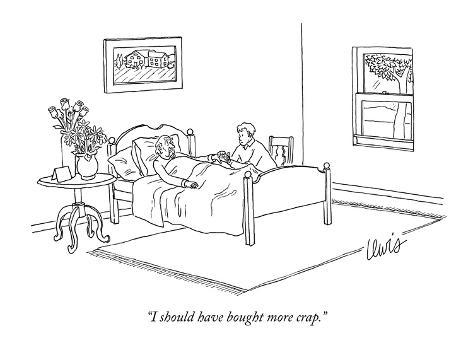
Of course, this cartoon is funny because it is ironic. If you find it humorous, you know that it is not true: A man lying on his deathbed and reflecting about meaning in his life does not say, "I should have bought more crap."
"Crap" of course provides an assessment of the ultimate value of possessions. It is telling, is it not, that we use the term "crap" as a synonym for "material possessions," and yet our culture remains nevertheless consumed with consuming material possessions.
But if happiness and meaning and satisfaction in life does not come by your buying more "crap," in what does it consist? Whence does it derive?
Cornell University psychologist Tom Gilovich, among others, suggests that, instead of consumption, instead of acquiring more things, we do better by acquiring more experiences.
Experiential "consumption" is more enduring. People tend to talk about their experiences more than their possessions. This in itself helps experiences to be means of social connections beyond the immediate circle of original participants. You can extend your experiences, enjoying them again with others or finding empathy from others when they were not so good. Or you can even laugh (after enough time has elapsed) about how awful those experiences were!
Herein lies the enduring value of experiences: you get to experience them, remember them, and to share them.
Your experiences affect and constitute who you are and who you are in relation to others.
Such sharing fosters empathy, both cognitive empathy ("I know what you mean!") and affective empathy ("I feel how you must have felt!"). It promotes bonding and greater awareness of shared humanity with expanding circles of solidarity. Tom Gilovich's research even suggests that people enjoy each other personally more when they talk about their experiences more than when they talk about their possessions. So there may be cultivated not only cognitive and affective empathy but also deeper relational affection itself.
Sharing by definition is a form of generosity. Benevolence is both pro-social and its own reward.
The implication is that, if you are going to try to "buy happiness," purchase an experience, not "more crap."
Monday, April 15, 2013
Cochrane's Alternative Maximum Tax
Today is the national tax filing deadline, tax day. And today John H. Cochrane of the University of Chicago wants to start a national conversation about a maximum tax. I will oblige him to some extent by linking to his blog post, which also appears as an opinion column into today's Wall Street Journal.
Friday, March 8, 2013
Rousseau and Flaubert on History
What is the role of historical progress, or its effects, in the thinking of two Frenchmen, Jean-Jacques Rousseau (1712-1778) and Gustave Flaubert (1821-1880)? In my last post, I compared Rousseau to Immanuel Kant (1724-1804) on the subject of what Enlightenment is and has done. In this post, I want to build on that by focusing more specifically on the question of history as it marched from the period of Enlightenment further into the period of modernity. And I want to explore this within the French borders. Kant and Rousseau were contemporaries but not countrymen. The opposite is true of Rousseau and Flaubert, and it may be beneficial to glimpse how successive generations of French writers saw things unfolding. Before turning to that, however, a refresher on the European context may be helpful.
Wednesday, August 8, 2012
Making Sense of Wilson, pt. 3b: Fairness
What about fairness and private property ownership? In my last post,
I mostly focused on applying Prof. Wilson's categories of fairness to
relationships between persons. These are important, and they are often
overlooked. We need to think, probably more than we typically do, about
relational fairness between individuals. But questions about fairness
between groups, particularly differences in ownership of property by
various societal segments, are also important and happen to be currently at the forefront of national conversation. So we
need to think about that, too.
Saturday, July 28, 2012
Conjugal Haves and Have-nots
In Sunday's The New York Times on July 15 appeared an article by Jason DeParle on "the way family structure deepens class divides." Among the observations is that children in two-parent homes tend to fare better than children in single-parent homes.
Much of this faring well is understood in the article economically: "striking changes in family structure [in the U.S. over recent decades] have also broadened income gaps and posed new barriers to upward mobility." Mr. DeParle continues, albeit in a somewhat attention-grabbing, Marx-related way of articulating these descriptive trends:
Estimates vary widely, but scholars have said that changes in marriage patterns -- as opposed to changes in individual earnings -- may account for as much as 40 percent of the growth in certain measures of inequality. Long a nation of economic extremes, the United States is also becoming a society of family haves and family have-nots, with marriage and its rewards evermore confined to the fortunate classes.
This is empirically revealing and helpful data for informed debate. But is marriage really "confined" to one segment of society in the sense that it is out of reach, or in the sense that a man and woman who wish to marry are not permitted to do so?
It may be the case, as Andrew
Cherlin, a sociologist at Johns
Hopkins University, says, that “[i]t is the privileged Americans who are marrying, and
marrying helps them stay privileged.” So the main question in my mind is, Why are not people marrying who might stand to benefit in numerous ways by so doing?
Education level is cited as a factor correlated to one's state of marriage and parenthood. The more educated a woman is, the less likely she is to have a child out of wedlock. A racial correlation exists but is decreasing. Multiple factors are interrelated, to be sure. I wonder, however, if the view of one of the subjects of Mr. DeParle's story about income levels and family structure is closest to the mark: “I’m
in this position because of decisions I made.”
These are not the words of a privileged outsider looking in on someone less wealthy. These are not the words of controversial sociologist Charles Murray, who argues in his most recent book that moral decline is responsible for matrimonial decline. (That book is reviewed in the NYT and WSJ; also available are a chat with readers, an op-ed, and summary essay.) These are the words of someone who is actually and personally affected -- by the decisions that she says that she made.
All of this brings to mind a topic from a previous post on poverty. In it, I reproduced a statement by Ron Haskins of the Brookings Institution. His main point in recent Congressional testimony is that certain behavior is an extremely accurate predictor of adult poverty or, alternately, of general economic success: "Young
people can virtually assure that they and their families will avoid poverty if
they follow three elementary rules for success -- complete at least a high school education, work full time, and
wait until age 21 and get married before having a baby."
Consider these statements from the article in the Times, which are congruous with Mr. Haskin's remarks:
- "Nearly half the unmarried parents living together at a child’s birth split up within five years."
- "Marital decline compounds economic woes, since it leaves the needy to struggle alone."
- "Forty years ago, the top and middle income thirds had virtually identical family patterns: more than 95 percent of households with children in either tier had two parents in the home. Since then the groups have diverged, according to [two researchers] Mr. Western and Ms. Shollenberger: 88 percent at the top have two parents, but just 71 percent do in the middle." [A different but related research finding is depicted in the nearby chart.]
- "While many studies have found that children of single parents are more likely to grow up poor, less is known about their chances of advancement as adults. But there are suggestions that the absence of a father in the house makes it harder for children to climb the economic ladder."

In other previous posts (two in May, here and here; and one in April), I also commented on family matters.
Upon continuing reflection, two important considerations occur to me. One is that the heightened contemporary concern about income discrepancy among Americans, the so-called haves and have-nots, may be legitimate, but it may need to be examined and discussed from a wider perspective than purely monetary differences. Mr. DeParle's article serviceably suggests that conjugal differences are related to income differences. To put a finer point on the broader perspective that may be required, increasingly cultural or lifestyle or -- may we actually say it -- moral differences, too, must be brought into the conversation about differences in income levels.
In addition, our examinations and analyses will benefit if we can move beyond the passive victim explanation (i.e., "Those people over there wholly did this to me!"). We may not be able to be content either with the opposite, active agent explanation (i.e., "You did this completely to yourself!"). The proper weighting of these two reasons for a certain state of affairs may be difficult in general to quantify. Neither may be the whole story. Both, however, passive and active, object and subject, victim and agent, explanations are relevant. Still, in the public debate, more room than currently seems popularly acceptable may need to be made at the table for the this-is-a-result-of-your-choices element.
In so saying, I do not wish to be misunderstood. Environmental factors beyond one's control do often influence the opportunities (or the perception one has of opportunities) about which one may make active decisions and in light of which one may pursue certain goals. Examples may include being
born into a family in a violent neighborhood, which entails pressures that limit educational
possibilities, or being born to a parent who has few inhibitions, which
leads to destructive effects that harm the child.
However, it seems equally obvious that individuals do, by and large, voluntarily if not always deliberately make decisions that have undesirable consequences for themselves. Individuals are not forced but rather choose whether or not to be married. They choose whether or not to behave in such a way that they may have children out of wedlock at a certain age. They choose whether or not to commit themselves to the laborious task of reconciling with a spouse in the wake of the contentious situations that arise in a marriage rather than divorcing. They even choose whether to (behave in such a way as to) complete at least a high school education or to seek full-time employment. All of these bear on one's financial prospects, income level, and upward mobility.
Why is this view, that an individual's decisions may bear on one's financial situation and that these decisions may be moral in nature, controversial? Let me offer a few suggestions.
However, it seems equally obvious that individuals do, by and large, voluntarily if not always deliberately make decisions that have undesirable consequences for themselves. Individuals are not forced but rather choose whether or not to be married. They choose whether or not to behave in such a way that they may have children out of wedlock at a certain age. They choose whether or not to commit themselves to the laborious task of reconciling with a spouse in the wake of the contentious situations that arise in a marriage rather than divorcing. They even choose whether to (behave in such a way as to) complete at least a high school education or to seek full-time employment. All of these bear on one's financial prospects, income level, and upward mobility.
Why is this view, that an individual's decisions may bear on one's financial situation and that these decisions may be moral in nature, controversial? Let me offer a few suggestions.
First, a possible reason is the nation's drift in culture, or character.
In the article in the Times, Mr. DeParle remarks, "Across Middle America, single
motherhood has moved from an anomaly to a norm with head-turning speed." The language of anomaly and norm reflects not just frequency of occurrence in the culture, as in a move from uncommon to common, but also a moral acceptance of single motherhood in the culture, as in a move from not acceptable to acceptable. If single motherhood does not carry the same social stigma, then that is because single motherhood is not viewed with the same moral disapprobation as previously. Whether this is because divorce, too, is more common and less stigmatized that earlier, or because reproductive technology is more accessible to more people, or because the sheer number of single parents makes it hard for people who know single parents to be critical of them, or even because being critical itself is frowned upon -- all of these things reflect both changing behaviors and a changing attitude toward matters of morality.
Answers to questions -- and the questions themselves -- are different. What shape should a nuclear family take? What sort of commitment does one actually make in marriage? What is marriage? What sort of family structure both is appropriate to and should best foster becoming a parent and discharging that loving, sacrificial duty? If I wish to be a mother but marriageable men are hard to come by, perhaps because men lack the desired and necessary moral qualities or character, should I go it alone through a means like sperm donorship and in vitro fertilization? A positive answer assumes that one has the means to pay for the technological procedure.
Or in the case of many inner cities, where poverty and violence are more common, if I have the same desire for a child and find few or no marriageable men not only because of the previous reasons but also because they are unemployed or incarcerated or dead, do I just have a child with my current boyfriend outside of marriage? This potential answer, of course, assumes something about the permissibility of pre-marital sex, itself a moral topic about which society's public moral opinion has changed. Pre-marital sex used to be frowned upon; now it is expected.
Or in the case of many inner cities, where poverty and violence are more common, if I have the same desire for a child and find few or no marriageable men not only because of the previous reasons but also because they are unemployed or incarcerated or dead, do I just have a child with my current boyfriend outside of marriage? This potential answer, of course, assumes something about the permissibility of pre-marital sex, itself a moral topic about which society's public moral opinion has changed. Pre-marital sex used to be frowned upon; now it is expected.
The family is a sphere
of life that is inherently moral in nature. In families we confront the messiness of human relationships; we realize the power of human sexuality, which connects us most intimately with another human; we find our notions of and capacities for commitment, sympathy, fairness, patience, and self-control tested. Insofar as marriage is
integral to family structure, which inescapably entails these things, marriage also, and any conception or
pursuit of it, is moral in nature.
This drift, first of individual behavior in community and then society's view of it, involves unavoidably the social conception of what is in fact moral. I mean "what is in fact moral" in the sense both of what is a moral matter and what is the proper way in which one ought to think or act about a particular matter. Both have broadly changed.
Second, and closely related, this morphed view of what is moral does not include cultural "lifestyles" or has relativized them. For this reason, so-called lifestyle choices are deemed irrelevant to the morality inherent in the income debate. To introduce them is to make a contested move.
If it is controversial that an individual's decisions may bear on one's
financial situation and that these decisions may be moral in nature, then this may be because activities like pre-marital sex, cohabitation, and single-parenthood are not viewed as moral matters. Where they are viewed as moral matters, they tend, as I have suggested, to be viewed as equally morally acceptable alternatives to abstinence, marriage as a conjugal union, and two-parent households. This shapes politically correct debate. These behaviors, in other words, are either off-limits (because they not seen as ethical in nature) or accepted (because ethical standards have been flattened). It is perhaps because they are accepted that they are off-limits. Certain family-related behavior is not illegitimate, but criticizing another lifestyle is impermissible. "You just don't do that these days." This is the new morality.
The nature of the family and its role in the social fabric used to be expected; now raising questions about variations from that previous expectation is frowned upon.
Third, accompanying the drift in the nation's culture and its reconfiguration of what is moral has been a greater abdication of individual responsibility and a tendency to assign blame to other agents.
The nature of the family and its role in the social fabric used to be expected; now raising questions about variations from that previous expectation is frowned upon.
Third, accompanying the drift in the nation's culture and its reconfiguration of what is moral has been a greater abdication of individual responsibility and a tendency to assign blame to other agents.
In a previous post, I drew attention to a suggestion made by Roger Scruton about his perception of growing ingratitude. According to his (quite sensible) view, when one receives something by grace, gratitude follows; when one receives something by justice, ingratitude follows. Grace is understood as an undeserved gift; justice is understood as an expected right.
In American society over the last fifty years (and even longer), more citizens receive monetary assistance of some kind from the federal government in greater amounts than in previous generations. These distributions are made in the name of justice. The discourse about them focuses on the distributions, and often prejudges them, as rights, a supposed right to health care, for instance. They are even referred to in the federal budget as "entitlements." Slowly and sometimes not-so-subtly the culture's assumptions about its own nature shift in this direction, too. The way in which I think about what I have in life, or should have in life, increasingly includes a component of that which I expect to receive from others owing to a form of justice.
Entailed in this evolving mentality is a diminished, although not obliterated, sense of individual responsibility and local community. Entailed also, on the other hand, is a magnified, although not total, sense of third-party (often state) responsibility for the national community. When I do not have what I expect to have by right (and often I may confuse what I wish to have and what I ought to have by certain just deserts), I find fault with some third party. I blame someone else. This is usually the third party that I believe is supposed to guarantee my rights (the state). It also often is the entity that I believe is preventing me from receiving what I suppose, whether by desire or justice, is now rightfully mine (the state and/or an economic system or a party or an industry or a company or a person).
How does this relate to conjugal haves and have-nots? Recall that the discussion about income discrepancies in the United States generally takes place at the
level of those who have agency, those who earn X and those who earn
Y. This is helpful to recall because the argument that I am trying to make is a moral one, namely, that an individual's decisions may bear on one's
financial situation and that these decisions may be moral in nature. When we speak of rights or what ought to be the case, we are squarely in the moral sphere. Assigning blame is a moral action and reflects a moral judgment.
A curious irony exists. The fact of disparity in income levels
is presented as a moral issue (e.g., "I am not receiving what I ought to receive"), but it is often also seen as illegitimate and
prejudicial to explain that disparity by way of other moral issues (e.g., the consequences of individual moral choices and habits some of which relate to family and sexuality). Put the other way around, why is it legitimate to cast the disparity in
income levels among persons in society as driven by immorality
(greed, exploitation, cronyism) but illegitimate to offer as a
contributing factor other forms of immorality (lack of self-control,
failures of duty, infidelity)?
I suspect that one answer, not far off the
mark, is that the former immorality (greed, exploitation, cronyism) is
committed by other agents but the latter (lack of self-control, failures
of duty, infidelity) are committed by the persons with the lower income
levels who claim to be hurt by the greedy, exploiting cronies.
What we find, then, is a propensity to criticize but not an openness to be criticized. We can "call out" other people's immorality, but we cannot bear to have them call out our own. We moralize selectively. Whether this is perhaps another moral shift in culture, or just intrinsic to human nature, it is strikingly reflected in contemporary American individual character, at least at the level of public debate.
Why is a moral understanding of the matter important? What is gained by identifying morality as involved in the descriptive relationship between marital and parental situation, on the one hand, and financial situation, on the other?
One benefit is that a moral understanding allows us consistently to hold together both passive and active causes of the income gap. Not only may an individual in some sense be on the short receiving end of some other group's morally dubious actions, but also individuals are in a real sense active agents in producing their own financial state of affairs. The former covers the "I'm not receiving what I ought to receive" notion; the latter covers the "these are some of the consequences of your individual moral choices and habits" idea. When we see both elements as moral, we may open up to better view than if we do not the nature of the problem, its origins, and potential remedies.
A second benefit is that we can thereby more acutely perceive the effect of the morality of public culture on public debate -- and we can talk more openly about that effect.
Public culture, what is accepted within a community, does imply notions of personhood and society to which persons and society should aim. These are goals of the group, and as goals they function as constraining norms. In this way we see that public culture influences behavior, which leads to consequences both for persons and for the group.
This is a significant observation that is all too often dismissed when it is claimed that culture is neutral. Usually that happens when culture is influencing ideas and behavior in the way that a partisan likes. In Justice as Fairness, John Rawls, the towering figure of modern political liberalism, writes: "We suppose, as a general fact of commonsense political sociology, that those who grow up in a well-ordered society will, in good part, form their conception of themselves as citizens from the public culture and from the conceptions of persons and society implicit in it" (122). Political liberals and conservatives both understand this "general fact": Culture's influence is always operative; that influence is powerful; and it powerfully influences identity and morals.
This is a significant observation that is all too often dismissed when it is claimed that culture is neutral. Usually that happens when culture is influencing ideas and behavior in the way that a partisan likes. In Justice as Fairness, John Rawls, the towering figure of modern political liberalism, writes: "We suppose, as a general fact of commonsense political sociology, that those who grow up in a well-ordered society will, in good part, form their conception of themselves as citizens from the public culture and from the conceptions of persons and society implicit in it" (122). Political liberals and conservatives both understand this "general fact": Culture's influence is always operative; that influence is powerful; and it powerfully influences identity and morals.
If the current debate about the sources of income gaps and class stratification is lopsidedly moral, namely, to the passive/victim/environmental explanation, then the lopsidedness itself says something noteworthy about the morals of the culture that the nature of the debate reflects. Less cumbersomely put, the focus of the debate reflects the prevailing moral disposition of the culture. In this case, the moral disposition may be a decided shift to rights-based thinking, enlarging statist institutions, moral blame-shifting, and ingratitude. Whether this is entirely accurate, we should, at the very least, pause to ponder whether how people conceive of themselves and of society is true to other moral sentiments that we may have (we might not be consistent), or that it may be legitimate to have (we might not have a monopoly on morality).
In writing this, specifically about a possible marked shift of this sort, I wish to be clear. I am speaking of the broad culture, not of every individual. Indeed, as we will remember, the lead subject in Mr. DeParle's article says of her situation: “I’m
in this position because of decisions I made.”
Wednesday, July 25, 2012
A Taxing Problem
Ari Fleischer writes in an op-ed in Monday's The Wall Street Journal about the latest Congressional Budget Office (CBO) report on U.S. taxation. Mr. Fleischer discusses this in connection with the presidential campaign rhetoric about the income tax system. He produces a graph, similar to a table produced recently by Harvard's Greg Mankiw, that helpfully illustrates the actual distribution of taxes paid by income level.

Based on the CBO report, Mr. Fleischer examines "the top 20% of income earners (over $74,000). They make 50%
of the nation's income but pay nearly 70% of all federal taxes. The remaining 30% of the tax burden is
borne by 80% of the taxpayers, those who make less than $74,000. In short, this
group's share of taxes paid, 30%, is lower than the share of income they earn,
50%."
He compares not just income level to percentage of federal taxes paid in the period under review (through 2009). He also tries to put this into historical perspective:
I doubt that the data that Mr. Fleischer presents will be disputed. What will be disputed is his interpretation of the data. It is important to remind ourselves of this distinction (data and interpretation of it), even generally, because it will help to clarify the moral issues that are debated and thereby to promote improved public discourse.the share of taxes paid by the top 20% has gone up over the last 30 years, while the share of taxes paid by everyone else has gone down. … The top 20% in 1979 made 44.9% of the nation's income and paid 55.3% of all federal taxes. Thirty years later, the top 20% made 50.8% of the nation's income and their share of federal taxes paid had jumped to 67.9%. … Meanwhile, the federal tax burden on middle- and lower-income earners is lighter. In 1979, the bottom 20% paid barely any taxes at all, just 2.1%. Now their share of taxes is a minuscule 0.3%.
Although I sympathize with the perspective that Mr. Fleischer advances, I also think that he misses something critical to the ongoing national conversation about monetary and tax "fairness." This is a complicated topic, but let me offer one observation.
When the president and others object to the current tax system on the grounds that many citizens do not pay "their fair share," they are objecting, among other things, not just to the rate at which certain citizens pay taxes (that the rate is too low) but also to the level of income on which taxes are paid (that the level is too high). It is both the tax rate and income level, taken together and with a view to a certain social end, that is viewed as unfair.
To say the same thing slightly differently, the issue in question is both the progressivity of the tax system and the spread between income levels. The wide spread between income levels now versus thirty years ago -- that is, the difference in earned income between the top and bottom quintiles -- may in fact be what prompts the outcry for greater progressivity in taxation than prevails at present. (This income discrepancy, by the way, is not a uniquely American phenomenon.)
I suspect that if the spread were narrower, then demands for greater tax fairness might be more muted. If some people did not make so much more money than others, then the issue might not seem in certain quarters to be so problematic.
This is important to note. It is a sense of unfairness about the spread between income levels that is effectively prior to -- and therefore it is this that motivates -- the sense of unfairness about the spread between average tax rates and share of income taxes paid. The widening income gap seems to some to be wrong (unfair); so current taxes paid on the high levels of income also seem to be wrong (unfair). At issue, in other words, is the understanding of fairness itself.
This is important to note. It is a sense of unfairness about the spread between income levels that is effectively prior to -- and therefore it is this that motivates -- the sense of unfairness about the spread between average tax rates and share of income taxes paid. The widening income gap seems to some to be wrong (unfair); so current taxes paid on the high levels of income also seem to be wrong (unfair). At issue, in other words, is the understanding of fairness itself.
Mr. Fleischer himself seems to recognize this, which is why he begins the op-ed in the way that he does, namely, by proposing one understanding of fairness: that "the amount you pay is based on the amount you make." This is fairness as equity.
His construction helps him to make his case, since he presents his data in light of that construction. He spotlights disparities in taxation relative to earnings. He, too, identifies unfairness; however, it seems to him to be "unfair" to those who have higher incomes. It is not unfair because they have higher incomes.
When viewed thusly, Mr. Fleischer's objection may not be to progressivity itself but to the degree of progressivity: that discrepancy in taxation is out of proportion to the discrepancy in income earned; it is too progressive; this spread is too wide. It is not equitable. The increase in the amount of taxes paid is greater than the increase in the amount of the nation's income earned. (See the nearby table.)
 But others
will object that "fairness" is not really or ultimately to be conceived
in terms of the amount of tax that one pays compared to the amount that one
earns. If it is, Mr. Fleischer will probably win the argument on that assumption along the lines of his op-ed. According to his detractors, however, fairness is not a matter of proportionality in Mr. Fleischer's sense, whether proportionality of contributions or proportionality according to merit. The driving sense of fairness on their view is not one of fairness as equity, but fairness as equality.
But others
will object that "fairness" is not really or ultimately to be conceived
in terms of the amount of tax that one pays compared to the amount that one
earns. If it is, Mr. Fleischer will probably win the argument on that assumption along the lines of his op-ed. According to his detractors, however, fairness is not a matter of proportionality in Mr. Fleischer's sense, whether proportionality of contributions or proportionality according to merit. The driving sense of fairness on their view is not one of fairness as equity, but fairness as equality.On this view, fairness is that system which leads to more equal social outcomes regardless of contributions or merit. (In some versions it may perhaps be fairness precisely in contradistinction to them.) It is fair to tax people differently, often very differently, if it is done with the goal of making more equal the primary goods of income and wealth (often through federal programs) across society but especially among those defined as the least advantaged.
This view, as I have articulated it, echoes that advanced by John Rawls, justice as fairness, a theory in which what he calls the "difference principle" operates: "the difference principle requires that however great the inequalities in wealth and income may be, and however willing people are to work to earn their greater shares of output, existing inequalities must contribute effectively to the benefit of the least advantaged. Otherwise, the inequalities are not permissible" (John Rawls: Justice as Fairness: A Restatement, 64; see also 122-24).
According to Prof. Rawls, the operative principle is not equity but his own special brand of reciprocity. (I say that it is special because reciprocity is usually, is ordinarily, an in-kind exchange between two parties, whereas that in view in Prof. Rawls's theory involves unlike transfers among multiple parties.) A controlling idea, then, in Prof. Rawls's view of justice, which has been in the air that many government officials have breathed for the last forty years since he first proposed it in 1971, has to do with acceptable differences across society as judged by a notion of reciprocity. And it is this notion of reciprocity that sheds light on one current group's sense of fairness:
To sum up: the difference principle expresses the idea that, starting from equal division, the more advantaged are not to be better off at any point to the detriment of the less well off. But since the difference principle applies to the basic structure, a deeper idea of reciprocity implicit in it is that social institutions are not to take advantage of contingencies of native endowment, or of initial social position, or of good or bad luck over the course of life, except in ways that benefit everyone, including the least favored. This represents a fair undertaking between the citizens seen as free and equal with respect to those inevitable contingencies. (124)
Professor Rawls advances this notion of justice as reciprocity, or fairness, by way of a thought experiment: what sort of society would representatives behind a veil of ignorance choose to create in a hypothetical original position? Policymakers advance something akin to this notion of justice as fairness not in an original position but at a different stage; they regulate society that is in its current position with constitutional essentials already settled. The goal of many current policymakers is, with reciprocity as a guiding light, to make progress toward the ideal through social and economic legislation and through the administration of related rules (see 47-49).
When politicians say that they only want the group with greater monetary wealth to pay its fair share of taxes, they do not refer to the statistics that Mr. Fleischer adduces. They appeal, instead, to a moral idea that is not dissimilar to that of Prof. Rawls's, even if it is not directly dependent on his teaching. The moral idea is that such a wide discrepancy in income as exists now between the top 20% of earners and the bottom 20% of earners -- which has widened over the last thirty years -- is permissible if and only if the wealth amassed by the top 20% works to the greatest benefit of those in the bottom 20%.
These politicians believe that such a benefit has not been realized. Because the more advantaged seem to be better off to the detriment of the least advantaged, it follows for them that unfairness exists and that greater taxation is a justified means of producing fairness. And fairness is what would be to the greatest benefit of the least well-off. Increased taxation -- which is a form of coercive state power -- on one group of society is a justified means of producing "fair undertakings," or just plain fairness, for the rest or whole of society. Hence, "fair share" on this view is the share that secures a fair distribution of monetary goods across society.
Until and unless we engage each other candidly at the formal level, inquiring sincerely about a person's view of fairness and pressing respectfully why that person believes in this sense of fairness and not another, we will be fruitlessly volleying material arguments back and forth.
Monday, June 11, 2012
Initiative in the Poverty Debate
These days, questions about justice, particularly that nebulous but ubiquitous term social justice, turn in my hearing mostly on the basic structure of life in the United States. It is a structure, it is claimed, that in its very fabric is unjust. Therefore, the unjust social fabric ineluctably results in inherently unequal opportunities, not to mention also unequal outcomes. A case in point, frequently offered as Exhibit A, is poverty.
Without discussing now the philosophical postulates about justice that this prevailing view reflects, I was struck by a report of Congressional testimony that was given last week on the subject of poverty. The Wall Street Journal reproduces in today's edition the following remarks by Ron Haskins of the Brookings Institution. (The Brookings Institution is generally considered a center-left think tank in Washington, D.C.) Mr. Haskins's point: certain behavior is an extremely accurate predictor of adult poverty or, alternately, general economic success.
Whatever one may think of Mr. Haskins's view, the Census data that he provides must be part of the ongoing political, economic, and moral debate. (The full transcript of his Senate testimony may be found here.)
Brookings Institution Senior Fellow Ron Haskins testifying before the Senate Finance Committee, June 5:I want to emphasize the importance of individual initiative in reducing poverty and promoting economic success. Young people can virtually assure that they and their families will avoid poverty if they follow three elementary rules for success—complete at least a high school education, work full time, and wait until age 21 and get married before having a baby. Based on an analysis of Census data, people who followed all three of these rules had only a 2% chance of being in poverty and a 72% chance of joining the middle class (defined as above $55,000 in 2010). These numbers were almost precisely reversed for people who violated all three rules, elevating their chance of being poor to 77% and reducing their chance of making the middle class to 4%.Individual effort and good decisions about the big events in life are more important than government programs. Call it blaming the victim if you like, but decisions made by individuals are paramount in the fight to reduce poverty and increase opportunity in America. The nation's struggle to expand opportunity will continue to be an uphill battle if young people do not learn to make better decisions about their future.A version of this article appeared June 11, 2012, on page A13 in the U.S. edition of The Wall Street Journal, with the headline: Notable & Quotable.
Wednesday, April 25, 2012
Competition and Federalism
"Should governments — of nations, states and towns — compete like business rivals?"
This question opens Greg Mankiw's opinion piece in the Sunday, April 15, print edition of The New York Times. The column reflects the Harvard professor's perspective, of course, but I found this a fairly even-handed discussion of the subject as it relates in particular to the matter of federalism. And he approaches it in a somewhat novel way. After explaining how competition among governments may benefit citizens, he summarizes the economic point in terms of political philosophy:
Whether competition among governments is good or bad comes down to the philosophical questions of what you want government to do and how much you fear government power. If the government’s job is merely to provide services, like roads, schools and courts, competition among governmental producers may be as good a discipline as competition among private producers. But if government’s job is also to remedy many of life’s inequities, you may want a stronger centralized government, unchecked by competition.What is noteworthy about this quote and the larger column is not that there exist philosophical differences about the purpose of governments. Noteworthy, rather, is how the economic notion of competition serves as a helpful heuristic for understanding these political differences. The point Mr. Mankiw is making is not about what sort of government sponsors a certain type of economic system. That is well-worn. His point, instead, it strikes me somewhat afresh, goes the other direction. It is how one may apply an economic idea as a way of grasping something central about a certain political system. In the present case, the political system in question is a federalist one, that is, one in which power is shared between a central, national government, on the one side, and discrete, state (and local) governments, on the other.
To be sure, that an economic system can throw light on a political system is not new (hence I say "somewhat novel"). You see that with rote rehearsals of Marxism all the time. I had not seen it before applied to federalism per se.
Mr. Mankiw's full essay may be found here.
Wednesday, April 11, 2012
Why Nations Fail
In a previous post, I provided a link to an interview with Daron Acemoglu in which he explains various theories about the causes of income inequality. The MIT economics professor and his Harvard collaborator James A. Robinson have written a new, popularly-targeted book on the fate of nations, Why Nations Fail: The Origins of Power, Prosperity, and Poverty. The book addresses a similar subject although in sweeping historical and global perspective (why do some nations become richer and others do not?) , and the authors advance one model for understanding it (because some governments develop inclusive political and economic institutions rather than extractive ones). William Easterly of the New York University reviews it here in the March 24 edition of The Wall Street Journal.
Wednesday, March 21, 2012
Inconsistency, Fallacy, & OWS
Last fall I was a bit confused by the entire Occupy Wall Street (OWS) phenomenon. So I asked two friends with polar perspectives to help me understand what was going on, what was at stake, how they assessed matters, and how the debate was taking shape. Having had now six months to reflect on things, here is some of what I gleaned.
Saturday, March 10, 2012
Mankiw on Rogoff on Lin
Okay, Greg Mankiw doesn't actually comment; he just excerpts a passage by fellow economist Ken Rogoff on NBA salaries and that of New York Knickerbocker and Harvard alumnus Jeremy Lin:
One can account for and perhaps justify these differences in various ways. But I've also often wondered about the same phenomenon: society seems to approve of extremely high compensation for celebrities and sports figures but to disapprove of the same for people in other professions.
Discrepancies in pay are often framed today in terms of justice, with the implication that disparities themselves (i.e., [widely] unequal portions) are not right. That is definitely one way to think about it, but I'm not sure that is the only or the best way to think about differences in compensation.
What amazes me is the public’s blasé acceptance of the salaries of sports stars, compared to its low regard for superstars in business and finance. ... Half of all NBA players’ annual salaries exceed $2 million, more than five times the threshold for the top 1% of household incomes in the United States. ... Lin’s salary, at $800,000, is the NBA’s “minimum wage” for a second-season player ...I did a little math. Lin's "minimum wage," given an 82 game season, is $9,756 per game, which itself is 48 minutes. So that is equivalent to $12,195.12/hour for game time (assuming Lin plays the entire game, which he doesn't). By contrast, the current regular minimum wage in the U.S. is $7.25/hour.
One can account for and perhaps justify these differences in various ways. But I've also often wondered about the same phenomenon: society seems to approve of extremely high compensation for celebrities and sports figures but to disapprove of the same for people in other professions.
Discrepancies in pay are often framed today in terms of justice, with the implication that disparities themselves (i.e., [widely] unequal portions) are not right. That is definitely one way to think about it, but I'm not sure that is the only or the best way to think about differences in compensation.


Subscribe to:
Posts (Atom)