Showing posts with label sympathy. Show all posts

Monday, January 21, 2019

Still Toying with "Tommy": On Kipling and Prejudice


It is a coincidence that today happens to be Martin Luther King, Jr., Day and I post a short blog note -- my first entry in some time -- on prejudice. My reflections are not on racial prejudice in the United States. There is unfortunately much of that still to be reflected on and rectified. What stimulates my thoughts is the poetry of a perhaps unlikely source: Rudyard Kipling.

In the estimation of George Orwell, "Kipling is a jingo imperialist, he is morally insensitive and aesthetically disgusting" ("Rudyard Kipling," Collection of Essays, 117). Orwell was a contemporary and published this essay in 1942, six years after Kipling's death. Orwell was also a writer of powerful pen and deep cultural observation. I, however, find what little I know of Kipling's verse to be complex -- complex with regard to imperialism, morality, and aesthetics. More than Orwell concedes, Kipling is at times artful in his moral critique of British imperialism and social prejudice.

Rudyard Kipling, 1895

One example comes from his poem "Tommy" (1890). The speaker is a common British soldier, who was by this time already known in slang as Tommy Atkins. Such soldiers then, as now, in both the U.K., the United States, and other countries, came often from the lowest socio-economic strata of society. They were much in demand as Great Britain expanded its imperialistic ambitions ever more globally afar in the latter half of the nineteenth century. They did the dirty work that made the crown sparkle with gems and ever increasing wealth. Kipling captures in this poem through Tommy's decidedly non-Oxford dialect a tension in British imperialism that consisted of not only prejudice against those foreign others but also those domestic others.

The speaker recounts in each stanza some experience of social prejudice, exclusion, ostracism, ridicule, moral snobbery, and a myopic concern for social justice. Then he follows each main experience with a varying chorus that points out the inconsistent ways in which not only proper British society and politicians but also bar maids and common theater-goers disregard "Tommy" (the familiar form of [dis]regard) in everyday situations, but quickly revert to "Mr. Atkins" (the respectful form of needy regard) when the topic turns to patriotic parades, military deployment, celebration of national heroes, personal protection, and defense from foreign enemies.

Striking, among other things, is the way in which the speaker captures how embarrassingly quickly disregard for him and his "kind" can turn to regard, nastiness can turn to need, jeering can turn to appreciation, and rejection can turn to reception. The aesthetic oscillation between the vocal forms of address "Tommy" and "Mr. Atkins" reflects the hypocrisy, or two-facedness, of those in society who so alternate.

Particularly indicting, it seems to me today, is the way in which politicians, as the speaker reports, can outwardly advocate improved military conditions and benefits for common soldiers, yet not only do they fail to deliver but they also miss what is most important to this common solider who would stand to benefit: humane, caring, consistent treatment face-to-face. The speaker says he would go without even more food provisions if those advocating them would just treat him like a valued human being: "We'll wait for extry rations if you treat us rational. / Don't mess about the cook-room slops, but prove it to our face."

Finally, the poem ends with the speaker's chilling reflection of social and moral condemnation: "An' Tommy ain't a bloomin' fool -- you bet that Tommy sees!" If there were any doubt about whether this hypocritical, inhumane instrumentalism of imperial and social convenience were done in the dark, the speaker removes it. He not only passively suffers; he actively sees. He experiences it painfully as he describes in so many situations, but what he ends with is a self-conscious recognition of his experienced injustice that, with the exclamation point, emphasizes his emotional anguish and the implied accusation. The sense is that this injustice does not escape notice -- and it will not escape judgment either.

Sometimes we need strong voices like those of "Tommy" or "MLK" to bring to light the various forms of inhumane treatment, marginalization, and prejudice in our own midst that work against human flourishing, consistent implementation of moral values, and social harmony.


Tommy

By Rudyard Kipling
(1890; reprinted in Barrack-Room Ballads, 1892)

I went into a public 'ouse to get a pint o' beer,
The publican 'e up an' sez, "We serve no red-coats here."
The girls be'ind the bar they laughed an' giggled fit to die,
I outs into the street again an' to myself sez I:
O it's Tommy this, an' Tommy that, an' "Tommy, go away";
But it's "Thank you, Mister Atkins," when the band begins to play
The band begins to play, my boys, the band begins to play,
O it's "Thank you, Mister Atkins," when the band begins to play.

I went into a theatre as sober as could be,
They gave a drunk civilian room, but 'adn't none for me;
They sent me to the gallery or round the music-'alls,
But when it comes to fightin', Lord! they'll shove me in the stalls! 
For it's Tommy this, an' Tommy that, an' "Tommy, wait outside";
But it's "Special train for Atkins" when the trooper's on the tide
The troopship's on the tide, my boys, the troopship's on the tide,
O it's "Special train for Atkins" when the trooper's on the tide.

Yes, makin' mock o' uniforms that guard you while you sleep
Is cheaper than them uniforms, an' they're starvation cheap.
An' hustlin' drunken soldiers when they're goin' large a bit
Is five times better business than paradin' in full kit. 
Then it's Tommy this, an' Tommy that, an` Tommy, 'ow's yer soul?"
But it's "Thin red line of 'eroes" when the drums begin to roll
The drums begin to roll, my boys, the drums begin to roll,
O it's "Thin red line of 'eroes," when the drums begin to roll.

We aren't no thin red 'eroes, nor we aren't no blackguards too,
But single men in barricks, most remarkable like you;
An' if sometimes our conduck isn't all your fancy paints,
Why, single men in barricks don't grow into plaster saints; 
While it's Tommy this, an' Tommy that, an' Tommy, fall be'ind,"
But it's "Please to walk in front, sir," when there's trouble in the wind
There's trouble in the wind, my boys, there's trouble in the wind,
O it's "Please to walk in front, sir," when there's trouble in the wind.

You talk o' better food for us, an' schools, an' fires, an' all:
We'll wait for extry rations if you treat us rational.
Don't mess about the cook-room slops, but prove it to our face
The Widow's Uniform is not the soldier-man's disgrace. 
For it's Tommy this, an' Tommy that, an' Chuck him out, the brute!"
But it's "Saviour of 'is country " when the guns begin to shoot;
An' it's Tommy this, an' Tommy that, an' anything you please;
An' Tommy ain't a bloomin' fool -- you bet that Tommy sees!

Friday, May 15, 2015

Emotions & Morals, pt. 5b: Reflections -- British Sense Theorists

Hutcheson, Hume, and Smith in their own distinctive ways were attempting to explore what counts as moral and -- although less explicitly or directly in their writings -- what should count as moral.  They did so by seeking to discover how human psychology worked and by giving due attention to the observation that we humans respond to moral matters powerfully and initially with our emotions.  They were engaging in an interdisciplinary study of ethics and psychology in light of Newton's recent findings of natural laws, and they saw a connection between the way that humans worked and what was proper or fitting for them to do or say in certain situations.  The precise basis for their normative claims is open to question, and the mechanics of human moral psychology are still being explored three hundred years later.

As I reflect on the relationship between emotions and morals through these three British sense theorists, an important consideration emerges, which is the nature of an emotion and its power in and over humans.  Hume seems to view emotions, or passions, as equivalent to but distinct from physical sensations, which is why he posits a separate faculty to process their moral content.  Emotions for him are given in the way that perception of an apple on a table is given. Are they really sensations like that?  Smith seems to have recognized that our feelings are not just given; they are malleable.  That is the basis, in fact, for his view of sympathy, or imaginative exchange with another person, and the device of an impartial spectator to evaluate and to question what was the proper passion to feel morally in a particular situation.  Smith's goal was emotional conformity to the impartial spectator's objective moral assessment of propriety and, to a secondary extent, utility.

Among many things that could be said, let me, in conclusion, mention only two. One relates to the passivity or activity of emotions, and the other pertains to the  narrative structure that emotions imply are connected to ethics.

Thursday, May 14, 2015

Emotions & Morals, pt. 5a: Reflections -- British Sense Theorists

Since introducing this short series of posts on the interplay between emotions and morals, I have taken a brief look at how the major British moral sense theorists -- Francis HutchesonDavid Hume, and Adam Smith -- addressed that question. It is now time for some reflections, which I will break up into two parts.

Each of the moral theories of these thinkers is subject to critique.  It is worthwhile to mention some limitations.  For the most part, however, I want to focus on what I think is perceptive and valuable in these theories and to note some areas that I think deserve additional consideration both in their own right and in their potential application to life.

Monday, May 11, 2015

Emotions & Morals, pt. 4: Adam Smith -- British Sense Theorists

Adam Smith is the last of the three major British moral sense theorists that we will examine in this series.  Smith was a friend of David Hume's, whom we discussed last time. Smith, much like Hume before him, saw himself engaged in moral science, the empirical description of how we as humans think about morals, how we make moral judgments, and how we assess the motivations, words, and actions of others.

Friday, May 8, 2015

Emotions & Morals, pt. 1: Introduction -- British Sense Theorists

Have you ever wondered about the interaction between emotion and reason in forming moral views?  The cartoon below reflects interactions that I am sure we have all had, just as it also reflects a presumed dichotomy between fact and value, reason and emotion, that I have in many ways come to question. Still, it humorously points to the "fact" that reason is not always the only or the strongest influence on belief.

What about our moral beliefs, those pertaining to what we consider virtuous? Our daily conversations with others presuppose the need to provide justification for our beliefs. But what exactly counts as justification?

Indeed, what will legitimately serve as adequate grounds for our beliefs and actions is often disputed. Many times the contention revolves around what one party thinks is based on reason (i.e., conclusions reached by deduction or induction from concepts or empirical data) rather than emotion (i.e., internal sentiments, impulses, or feelings). And the other party might take sentiment to be quite adequate grounding, or at least part of it.

Friday, December 5, 2014

Lear: The "Abused Nature" "Of This Child-Changed Father"

One of the great pleasures in reading literature is to discover a few sentences or lines that are so rich with significance that they simultaneously do two things.  On the one hand, they deepen the narrative, play, or poem as it advances, and, on the other hand, radiate, and encapsulate, the work’s broader meaning and concerns.

In Shakespeare’s King Lear, Act 4, scene 7, lines 16-19, Lear’s youngest daughter Cordelia meets her father and becomes overwhelmed by his state of affairs:  his dementia and his abandonment -- more than that, his abuse and rejection -- by his other two elder daughters Goneril and Regan.  Cordelia interrupts her speech with an apostrophe to the “kind gods,” and she prays that Lear may be healed.

CORDELIA                                           O, you kind gods,
Cure this great breach in his abusèd nature!
Th’ untuned and jarring senses, O, wind up,
Of this child-changèd father!
-- King Lear, IV.vii.16-19

The short passage is pregnant with significance, especially double meanings.

First, “abused nature” refers most immediately to his madness (i.e., insanity).  Cordelia finds his unmooring from reality to be particularly pitied.  These are his “untuned and jarring senses.” At the same time, the “abused nature” signifies the natural relationship of father and daughter that Goneril and Regan have “abused” in not patiently caring for their aging, ailing father and in their acute hostility toward him. This is also, as much as the dementia, the “breach” in his natural constitution:  as a person of sound mind and as a father of (falsely) doting daughters.  Ironically, it was Cordelia who in Act 1 affirmed her love for Lear “as are right fit” (1.1.107) and “according to my [natural filial] bond” (1.1.102), yet whom Lear rejected, abused, by disowning and banishing from the kingdom. 

"Lear and Cordelia," Ford Madox Brown, 1848
Second, the other petition in Cordelia’s prayer is for the gods to “wind up,” or to mend or fix, the senses (the mental, perceptual, and emotional capacities) of this “child-changed father.”  The image may be one of a chiming clock, “untuned and jarring,” imprecise in reflection of reality (as a clock that needs to be wound) and jarring in the sound it makes as a result of its chiming at the wrong time. Lear himself variously lashes out and speaks nonsense because of the two factors that so plague him:  his failing mental capacities and his shattered family relationships with his children.  He is, both because of his own banishment of Cordelia and because of Goneril’s and Regan’s essential “banishment” of him, a “child-changed father.”

This passage, then, echoes succinctly a key, overarching, tragic irony of the play. Lear himself, because of his combined natural, hasty, manic disposition and his increasing dementia, rejects genuine affection where it was to be found (Cordelia) and is himself rejected by false affection where he chose, in his foolish pursuit of public professions, to believe it was true (Goneril and Regan).  Cordelia perceives and feels deeply the tragedy of Lear’s losing himself and his ties to his daughters, both of which are abuses to his nature.

Tuesday, October 28, 2014

The Economy and Pursuit of Happiness

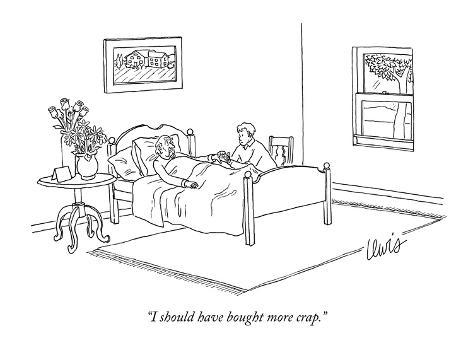
In an earlier post, I discussed the economics of empathy.  That post pertained to both empathy and thanksgiving.  I recently ran across this New Yorker cartoon, which summarizes much positive psychological research into acquiring happiness.


Of course, this cartoon is funny because it is ironic.  If you find it humorous, you know that it is not true:  A man lying on his deathbed and reflecting about meaning in his life does not say, "I should have bought more crap."

"Crap" of course provides an assessment of the ultimate value of possessions.  It is telling, is it not, that we use the term "crap" as a synonym for "material possessions," and yet our culture remains nevertheless consumed with consuming material possessions.

But if happiness and meaning and satisfaction in life does not come by your buying more "crap," in what does it consist? Whence does it derive?

Cornell University psychologist Tom Gilovich, among others, suggests that, instead of consumption, instead of acquiring more things, we do better by acquiring more experiences.

Experiential "consumption" is more enduring.  People tend to talk about their experiences more than their possessions.  This in itself helps experiences to be means of social connections beyond the immediate circle of original participants.  You can extend your experiences, enjoying them again with others or finding empathy from others when they were not so good. Or you can even laugh (after enough time has elapsed) about how awful those experiences were!

Herein lies the enduring value of experiences:  you get to experience them, remember them, and to share them.

Your experiences affect and constitute who you are and who you are in relation to others.

Such sharing fosters empathy, both cognitive empathy ("I know what you mean!") and affective empathy ("I feel how you must have felt!").  It promotes bonding and greater awareness of shared humanity with expanding circles of solidarity. Tom Gilovich's research even suggests that people enjoy each other personally more when they talk about their experiences more than when they talk about their possessions.  So there may be cultivated not only cognitive and affective empathy but also deeper relational affection itself.

Sharing by definition is a form of generosity.  Benevolence is both pro-social and its own reward.

The implication is that, if you are going to try to "buy happiness," purchase an experience, not "more crap."

Monday, March 31, 2014

The Human Status of Frances Kamm

What if you could have a thirty-minute conversation with each of eleven distinguished people about their views on a subject in which you were keenly interested?  What would you think?  If you are like me -- and if that subject was, say, moral philosophy -- you would be a little giddy.  So you can imagine my excitement when I ran across and began to read a recent book by Alex Voorhoeve, Conversations on Ethics (2009).

As a way of processing these conversations, I intend to post some reflections on each, starting now with the conversation that Frances Kamm has with Alex Voorhoeve.  Professor Kamm points to what she believes is the deep structure of morality.  The impetus for this in her life as a philosopher was a graduate seminar taught by Robert Nozick, who earlier in Anarchy, State, and Utopia had introduced the so-called "paradox of deontology."

The paradox of deontology involves this tension.  Assume that, on the one hand, you believe that everyone possesses the same rights against being harmed in a certain way, but then ask, on the other hand, how would you answer this question:  "If you could save Abby and Betty from being harmed in that way by instead harming Calvin, why would you not harm the one to save the two?"

Thursday, March 6, 2014

DFW and the Fundamental Attribution Error

A couple of weeks ago I decided to revisit David Foster Wallace's famous Kenyon College commencement address from May 21, 2005.  It was subsequently revised and published as "This Is Water."  (The audio and various text editions, including a transcription of the original speech and one cleaned up, are easily available on the web.)  Among many things that struck me upon both rereading and listening to the address, one thing jumped out in particular.  And I think it is one key reason that DFW's address went viral back then and is still discussed now.

Tuesday, September 24, 2013

The Ethical Imagination of Art

Why, when we see acts of apparent selflessness, do we often swell with emotion?

Why, to put an even finer point on this, when we observe even fictional gestures of sincere compassion, do we pause, tear up, reach for a tissue or a nearby loved one, and become seized with something that transcends admiration -- something that feels like melting?

Art, in its various forms, uniquely taps into the human imagination, grips our emotions, and, if we listen, instructs.  Take, for example, the following short video clip, which of late, and deservedly, has been making the social media rounds.

(The YouTube link for the video is here.
The brief article about the video from Gawker is here.)


Sunday, September 22, 2013

Empathy in Kafka and in Life


Franz Kafka’s fantastic stories of “The Metamorphosis” and “A Country Doctor” present a narrative world that not only assumes the reader’s suspension of disbelief but also requires it.  The stories require it in order to generate in readers appropriate empathy with the characters. These two acts -- (1) the willingness to engage in the narrative world and (2) the resulting emotional engagement with the characters in their relational contexts -- enable literature to foster empathy with others in a way that transcends the constraints imposed by relational life outside of literature. “The Metamorphosis” in particular facilitates in the reader a transformation of understanding by narrating Gregor Samsa’s transformation of being.

Saturday, August 31, 2013

Moral Ambiguities in Prévost, pt. 2: Autonomy and Empathy

In my previous post on moral ambiguities in Prévost's Manon Lescaut, I observed how, even when characters and stories are explicitly said to be moral examples, the precise nature of the moral instruction may not be clear.  In particular, I asked of the ethical lesson reflected in the Chevalier des Grieux's interactions with others, "Is one to avoid (being duped into) compromising one’s moral judgment because of compassion, or, positively, to pity a libertine and lighten punishment?  Is one to recognize that pity is a virtue but that manipulating it for self-gain and moral license, as Des Grieux does, is a vice?"  In this post, I simply want to mention a couple of ways in which these questions are as alive for us today as they were for Abbé Prévost in the 1700s:  the relationship between autonomy and empathy in moral evaluation.

Friday, April 12, 2013

An inch of difference?

What difference does an inch make?

That is really the question raised by this USA Today column, "We've Forgotten What Belongs on Page One."

The author writes about the events that form the basis of an ongoing trial in Philadelphia about infanticide performed routinely by a physician. The question surrounds the seemingly artificial, in the author's eyes, distinction between what is moral and what is legal:
...whether [the doctor] was killing the infants one second after they left the womb instead of partially inside or completely inside the womb — as in a routine late-term abortion — is merely a matter of geography. That one is murder and the other is a legal procedure is morally irreconcilable.
So an inch makes the difference between what is illegal and what is legal, between permissible termination of a life and the impermissible termination of it.

The details that emerged during the trial and that are described in the column are just horrifying.  The trial seems to highlight the real dispute at issue:  not when does life begin but when does life become socially valuable?

Our enlightened society and its legal system have an answer. An inch makes all the difference.

Ralph Waldo Emerson is famous for writing in his essay "Self-Reliance" that "[a] foolish consistency is the hobgoblin of little minds, adored by little statesmen and philosophers..."  Apparently, little statesmen are also wont to adore foolish inconsistencies.  And it reflects the smallness of their minds.

Monday, March 25, 2013

Darwin and Nietzsche on Genealogy

Taking a genealogical approach to an idea -- what is its lineage, family tree, or antecedent chain of births? -- is not new.  Jean-Jacques Rousseau had arguably taken a similar approach to moral degradation and inauthentic living in his "Discourse on the Origin of Inequality" (1754).  (See, e.g., two prior notes on this, here and here.)  It does seem, however, that genealogy more explicitly comes into its own as a method of inquiry in the nineteenth century.  Sigmund Freud himself later will follow much the same path in Civilization and Its Discontents (1930).  When one reads Freud's exploring the genealogical history of human unhappiness with civilization, which he explains by tracing the evolution of guilt in the development of the super-ego, one detects not only the influence of Rousseau's incipient genealogical explorations, but also the more mature and distinct projects of nineteenth-century luminaries Charles Darwin and Friedrich Nietzsche.

Friday, September 21, 2012

Making Sense of Wilson, pt. 9: Universal Impulse

In a prior post in which I reflected on James Q. Wilson's book The Moral Sense, I drew attention to the universal impulse in moral sentiment that he identifies:  "The most remarkable change in the moral history of mankind has been the rise -- and occasionally the application -- of the view that all people, and not just one’s own kind, are entitled to fair treatment" (191).  Because it is so remarkable, and because it has such sweeping implications, it is worth probing further this topic about the development of universalism in moral thinking and practice.

We can begin by focusing on a question that Prof. Wilson himself poses:  "How can we explain the great expansion of the boundaries within which the moral sense operates?  How, in particular, can we explain why we believe that moral rules ought to have universal applicability?  This aspiration toward the universal is the chief feature of the moral history of mankind" (194).  Indeed.

Professor Wilson suggests that the long development of consensual marriage, particularly in northwestern Europe, helps to provide a key, but not the only, component of an explanation.

The link between the two, consensual marriage and universal moral applicability, may not be immediately apparent.  The tie, however, is the parallel development in northwestern Europe of individualism.  What is the connection?

Friday, September 14, 2012

Making Sense of Wilson, pt. 8: Gender

The pertinent question is an old one:  how do natural differences between men and women manifest themselves in their respective moral senses? 

Tuesday, August 21, 2012

Terminating 2 at 20

Exercising her right to choose ... to kill her twins.
I ran across a disturbing opinion column from one week ago about a woman in Florida who was pregnant with twins.  "Was."  She is pregnant no longer.

No, she was not a sad victim of urban violence -- but her twins were.  She terminated them at twenty weeks of gestation.  She ended their lives half-way through her pregnancy.  Why?  For the supremely sensible reason that ... she just didn't want them, and she felt nothing for her twin children.

The website on which the column appears is littered with annoying political ads, and the column itself ends with an appeal to "the church" that may not make sense to readers or even follow from the text that precedes it.  But what the column does do well is to bring to attention how commonplace this sort of ending of innocent life is in the United States.

It also prompts questions in my mind about what sort of person possesses such a psychological and emotional disposition that she does not think twice about killing the two twin children who are so visibly alive and growing in her womb.  What really causes a person to feel and act that way?

Thursday, July 19, 2012

Making Sense of Wilson, pt. 2: Sympathy

In part 1 of this series of my reflections on James Q. Wilson's book The Moral Sense, I summarized the book's main aims and shared a few of the most salient points that I found of conceptual and practical value.  In this post, I begin to tackle the book's second section, which examines four key moral sentiments:  sympathy, fairness, self-control, and duty.  Specifically I focus on sympathy.

As preparation for a review of moral senses such as sympathy, it may be helpful to recall what Prof. Wilson is and is not doing by exploring these sentiments:
I am not trying to discover "facts" that will prove "values"; I am endeavoring to uncover the evolutionary, developmental, and cultural origins of our moral habits and our moral sense. But in discovering these origins, I suspect that we will encounter uniformities; and by revealing uniformities, I think that we can better appreciate what is general, nonarbitrary, and emotionally compelling about human nature.  (26)
In the chapters on the four moral sentiments, Prof. Wilson does just this.  He weaves together the evolutionary, developmental, and cultural origins of these respective moral habits and senses.  In doing so, I find his descriptive observations -- which are helpful in their own right as an organizing heuristic for thinking about moral matters -- to pull me toward practical considerations and action.

I offered a few remarks on sympathy, "the human capacity for being affected by the feelings and experiences of others" (30), in the earlier post.  It helped to exemplify the basic approach to the subject that Prof. Wilson takes.  Sympathy, like the other sentiments, functions in human life as both a motivation for moral action and a standard for it.  A few other brief notes are worth mentioning.

In all of his chapters on the sentiments, if to varying extents, Mr. Wilson explores the relevance of evolutionary biology on the moral sense in view.  The theory of inclusive fitness, advanced by William Hamilton after Charles Darwin, fills out the latter's theory of a species' successful self-propagation over time:  "An individual is reproductively successful to the extent that his genes occur in the next generation, and he can assure that occurrence not only by reproducing himself but also by assisting in the reproduction of individuals who have his genes" (41).

Professor Wilson admits that this theory might explain why we humans sacrifice ourselves for our kin, but it does not go very far in explaining why we humans are willing to sacrifice ourselves for our grandmother, who is past childbearing age and cannot deposit genes to future generations.  It also does not explain why we may rush into a burning building to save a dog or adopted children, with whom we have no genetic similarity (42).

Maybe the notion of reciprocal altruism can help:  "we engage in altruistic acts -- such as helping nonrelatives, caring for adopted children, or being affectionate toward pets -- in order to impress others with our dependability and hence to increase our opportunities to have profitable exchanges with these others" (43).  Mr. Wilson points out that as an explanation this utilitarian idea has truth elements to commend it, but a more basic motivation -- "a prior, dominant fact" (44) -- must be recognized.  We more basically value reciprocity in human relationships to which we are naturally drawn because we fear isolation and loneliness and we value human sociable companionship.  This human trait governs the theory of altruism, and it is at the heart of sympathy.

What can be said about evolution and sympathy, then, is this:  "If sympathy is widespread, it must have been adaptive, but what was selected for is a generalized trait that both encourages reproductive fitness and stimulates sympathetic behavior.  That trait, or adaptive mechanism, is attachment or affiliative behavior" (44; emphasis original).

We are naturally more sympathetic to those to whom we are most similar.  Humans naturally think of themselves first in terms of a small group (a nuclear family, an extended kinship, a local community, religious group), but we can imagine ourselves as part of a larger sphere and, with extra effort, behave sympathetically toward those who differ from us in race, religion, and culture.  Earlier, Prof. Wilson makes the keen insight that "life-styles" today is the nonjudgmental word for what used to be called "character," and I might broaden that to say "culture" (7).  This is a point that illumines the linguistic shift which has occurred in morality and permissible moral discourse, on the one hand, and that, on the other, contemporizes the tendency toward small group affiliation, toward those who live life as we do.

Two towering moral philosophers, both Scotsmen, in their own way identified sympathy as either the source of moral sentiments (Adam Smith) or at least as one of the two extremely powerful and basic sources along with utility (David Hume).  Both men viewed moral philosophy as inextricably linked to the study of human nature.  The place of sympathy in the thought of other philosophers could be mentioned, but the central place of it in Smith's and Hume's writings should prompt us to reflect more than we typically do -- or I have done -- on what it is, how it is manifested, and how it might be cultivated.

Sympathy can lead to benevolent feelings and actions, Mr. Wilson notes, but we should not limit sympathy to the rosier side of life:
Sympathy is often expressed by phrases that convey not tenderness or concern, but anger and vengeance.  If we see an abominable act -- say a man laughing while torturing an innocent baby -- our first reaction is not likely to be an expression of sympathy for the child but rage at its tormenter; and this will be true even if it is not our child.  Sympathy is often wrongly portrayed as entirely a tender sentiment:  sympathetic people are sometimes described as soft, warm, or weepy.  They often are; but they are much more than that, and some of the most sympathetic people have no trace of cuddliness in their temperament.  Even so staunch a utilitarian as John Stuart Mill recognized this:  "It is natural to resent and to repel or to retaliate any harm done or attempted against ourselves or against those with whom we sympathize." (40)
If we do not limit sympathy to the soft and warm side of life, then we should perhaps also be prepared to view anger and vengeance as legitimate moral responses that stem from not just a sense of justice but also of sympathy.

In this way, we may also have stumbled upon an important observation:  moral senses such as sympathy and justice are connected.  We may not be able to say (yet) with someone like Adam Smith that sympathy is the primary cause of moral sensibility.  But we recognize that there is interplay between the moral senses.

Moreover, if there is any truth to the commonplace that men and women are different (a truism to which some do in fact object), and if on the whole it is the case that women naturally display the tender and sensitive side of sympathy more than do men, then men would do well to remind themselves that such sympathy may be a manifestation of moral sense.  And it may be a commendable moral expression just as much as the stereotypical male tendency to display the more violent and vengeful side of sympathy.

If they are so tempted, men, in other words, should not diminish women's proclivity to soft sympathy.  Women, likewise, should not diminish men's proclivity to hard sympathy.  Both may be appropriate, admirable actions stemming from a developed moral sense.  If morality is valued, then the various expressions of the moral senses should also be valued.

To be sure, members of each sex can and often do display the moral trait that I have associated as more typical of the other.  The point is not gender stereotypes per se but better mutual appreciation among the sexes.  Professor Wilson's discussion of sympathy, which recognizes its pluriformity, provides men and women enhanced grounds for doing what they already know that they ought to do:  live patiently in an understanding way with one another.  Sympathy has come full circle.

Wednesday, July 11, 2012

Making Sense of Wilson, pt. 1

I finally completed James Q. Wilson's The Moral Sense.  I have mentioned the book in previous posts; I will again -- and for good reason.  The late Prof. Wilson's accessible writing is marked by his massive erudition and incisive reasoning.  It offers much from which one may learn, even if one disagrees with parts or the whole.

Because I find the volume so worthwhile, I plan to post a series of reflections on it.  As with this entry, summaries will be followed by ruminations.  I do not pretend that my posts of gleanings will do justice to the book.

The book is about human nature.  In particular, it is about the moral sensibility that is inherent in human nature and cultivated accordingly.  In arguing that there is such a sensibility, Prof. Wilson finds himself at odds with many academic gatekeepers.  He contends that "an older view of human nature than is now current in the human sciences and moral philosophy is the correct view; thinking seriously about the kinds of animals we are will help us understand our persistent but fragile disposition to make moral judgments and the aspects of human relations that must be cultivated if that disposition is to be protected and nurtured" (vx).

To say that this disposition is something that may be "protected" assumes that it exists, and Prof. Wilson marshals plenty of supporting evidence.  That is the point:  "This book is a modest effort to supply the evidence that man has a moral sense, one that emerges as naturally as his sense of beauty or ritual (with which morality has much in common) and that will affect his behavior, though not always and in some cases not obviously" (25).

To say that one might want this moral disposition be "nurtured" affirms that that to which this sensibility disposes humans is potentially valuable.  Indeed, this positive moral trajectory seems to be where Prof. Wilson places the accent in his discussion:  "Beneath our wars, crimes, envies, fanaticisms, persecutions, snobberies, and adulteries; beneath, that is to say, all of those human traits that might be said to constitute our original sin, there is a desire not only for praise but for praiseworthiness, for fair dealings as well as for good deals, for honor as well as for advantage" (vx).  It is these desires, or sensibilities, and their sources that Prof. Wilson examines.

Although one can reasonably argue for more such moral senses common to almost all people than those that Prof. Wilson treats, he covers much ground with these four:  (i) sympathy, (ii) fairness, (iii) self-control, and (iv) duty.  Next time I will focus on these.  For now, I wish simply to comment on some overarching, framing matters.

To identify these ethical inclinations as Prof. Wilson does is not to identify a set of moral rules (see 11).  But it is in various ways "an attempt to clarify how we evaluate human behavior, and so [the book] starts with judgments in order to discover what we are praised for doing.  Almost everyone has a moral sense that is evident when we speak disinterestedly about our behavior or that of others.  We regularly praise and condemn other people's speech and conduct" (24-25).  There may be a place for rules.  What is more interesting to me is the everyday nature of morality, or moral sensibility, that is highlighted.  This is where most people live.

First, how conscious are we that when we condemn or praise others we are making moral claims?  This may be apparent for things like cheating (it violates our sense of fairness, which is a form of justice) or adultery (it violates our sense of loyalty, which is a form of self-control).  But it extends to more mundane behaviors, too.

When we say that someone is meanspirited, we are judging that meanspiritedness as behavior that ought not to occur; the person should have behaved with kindness instead.  Why?  Because we generally value or find praiseworthy kindness more than we do spite.  The former is the virtuous or moral alternative to the latter.

In this vein, Prof. Wilson discusses sympathy.  This is getting ahead of ourselves somewhat, but it will help to advance the present point.  He writes that sympathy is
the human capacity for being affected by the feelings and experiences of others.  Sometimes sympathy leads us to act altruistically; usually it does not.  More often it restrains us from acting cruelly.  And even when it does not inspire benevolent actions, sympathy is an important source of the moral standards by which we judge both others and ourselves.  Sympathy, in other words, is both a motive and a norm. (30)
We probably agree that sympathy is a motivation for our behavior, but we might ask, How does sympathy also function as a standard, a moral norm, for behavior?  Professor Wilson suggests that our motivation derives from our natural (biological and emotional) sociability.  We desire to be admired by others and so to please them, not to offend them.  In other words, we exist in relationship with others and desire to promote the mutual relational interaction.  To this end, "we must imagine" what others think and feel.  In imagining, we judge in this way:
More particularly, we judge whether the actions and feelings of another person are proportionate.  A rich boy distraught at the loss of a penny arouses not sympathy but derision; a boy indifferent to the loss of a loving dog arouses not sympathy but disdain.  We approve of the conduct and character of another person if, when we imagine ourselves in this position, our feelings correspond to those that we think motivate him. ... Sympathy -- our sense of another's feelings and of their appropriateness given the circumstances -- is the basis of our judgment.  (32)
If this account is roughly accurate, then feelings have a much larger role not just in our moral motives but also in our moral standards than perhaps many of us have been conditioned to suppose.

This is a second noteworthy item of the first section of The Moral Sense:  the role of emotions or feeling in both moral interactions and moral calculations.

To admit a place of emotions in moral reasoning may seem odd, but it also seems to make perfect sense.  As I thought about this from the perspective of engaging others on often controversial topics (because morality is typically a disputed subject), it struck me that a perhaps (more) fruitful way of conducting these conversations is to be sensitive to and aware of other people's emotional responses to the topics under consideration.

Some of us find it relatively easy to explain why we think what we do about a moral topic.  Others do not.  Often it is also the case that people have difficulty mustering arguments for their firm position on a moral topic.  It is therefore helpful to remember this:  "The feelings on which people act are often superior to the arguments that they employ" (8).

Why is this helpful?  It will help us to learn to practice patience in our own lives as we interact with people who may display inconsistency (as we all do) between our words and actions and who may not be able to verbalize their moral feelings.

Second, the feelings on which people act may give us a better barometer of what positions people actually hold, despite what they say.  It will help us to understand -- to sympathize with, as it were -- our family members, friends, or other conversation partners, because we understand the integrity of moral sensibility in persons:  it involves not just their mental senses but also their emotional senses, which prompt physical actions.  We become, as it were, more holistic readers of moral philosophy.

Third, in being patient with others and sympathizing with them so as to understand them better, we will also likely perceive more constructive avenues to pursue in our actual dialogues and interactions.  Where is there more common ground than we might otherwise have assumed?  What is the heart of the matter or disagreement, if there still in fact is one?  Are we approaching the same point in different ways?  How should we best carry on the conversation from here?

Fourth, we will learn to be more self-aware.  We will hone the ability and discipline to discern when emotions are compelling us to respond to justice or injustice, to something praiseworthy or condemnable. And we will better be able to identify which ones they are and why.

In this connection, we may wish to ask ourselves these questions or ones like them.  "Why am I feeling this way about what she just said?  Is it a moral response?"  Or, "Why do I have this physical reaction to what he just did?  What is the connection with my sense of what is right?"  In so doing, we will actually deepen our social relationships with people, because we will be more in tune with, and frankly concerned about, the deeper principles that individual occurrences reflect.  I suspect that we will also be led to better appraisals of ourselves and others.  And in time, with faltering steps -- and by honing our senses of sympathy, fairness, self-control, and duty -- we will probably be able to cultivate not only more substantive relationships but also more virtuous responses to them.

Monday, July 2, 2012

The Dark Knight (of Taxing) Rises

In an effort at once to sympathize with those who find themselves in the minority and to recognize respectable reasoning through a topic when it arises, I reproduce in full today's rather lengthy editorial in The Wall Street Journal.

A Vast New Taxing Power

The Chief Justice's ObamaCare ruling is far from the check on Congress of right-left myth.

The commentary on John Roberts's solo walk into the Affordable Care Act wilderness is converging on a common theme: The Chief Justice is a genius. All of a sudden he is a chessmaster, a statesman, a Burkean minimalist, a battle-loser but war-winner, a Daniel Webster for our times.
Now that we've had more time to take in Chief Justice Roberts's reasoning, we have a better summary: politician. In fact, his 5-4 ruling validating the constitutional arguments against purchase mandates and 5-4 ruling endorsing them as taxes is far more dangerous, and far more political, even than it first appeared last week.
This is a minority view. By right-left acclaim, at least among elites, the Chief Justice has engineered a Marbury v. Madison-like verdict that camouflages new limits on federal power as a reprieve for President Obama's entitlement legacy and in a stroke enhanced the Supreme Court's reputation—and his own. This purported "long game" appeals to conservatives who can console themselves with a moral victory, while the liberals who like to assail the Chief Justice as a radical foe of democracy can continue their tantrum.
It's an elegant theory whose only flaw is that it is repudiated by Chief Justice Roberts's own language and logic. His gambit substitutes one unconstitutional expansion of government power for another and rearranges the constitutional architecture of the U.S. political system.
***
His first error is the act of rewriting the plain text of a law, instead of practicing the disinterested interpretation that is the task of the judiciary, regardless of the partisan outcome. The second error is converting the health insurance mandate's penalty into a tax. Ninety years of precedents have honed precise and widely divergent legal meanings for taxes and penalties for violating laws or regulations, and they are not interchangeable.
The Chief Justice did not simply change a label—as if Congress said something was a penalty when it was really a tax. Rather, these categories are defined by their purposes and effects, by how they operate in practice. Taxes are "exactions" whose main goal is raising revenue, while penalties punish individuals for breaking the law. The boundaries can blur—legitimate taxes may also have strong punitive aims—but scarcely so in this case. ObamaCare's mandate was designed to regulate individual conduct to help achieve universal coverage. If it succeeds perfectly, it should collect $0.
Even if Democrats had passed the mandate tax as rewritten by the Chief Justice, and they did not, the Supreme Court until Thursday has never held that Congress can call anything it wants a tax. The taxing power like the Commerce Clause is broad, and the courts are generally deferential. But all powers the Constitution enumerates are also limited, and these limits—unique to each power—must be meaningful and enforceable by the legal system.
The Chief Justice's compounding errors deprive the taxing power of any viable limiting principles. Article I, section 8 gives Congress an independent grant of power to "lay and collect Taxes, Duties, Imposts and Excises, to pay the Debts and provide for the common Defence and general Welfare of the United States." Taxes must originate in the House, the political body designed to be most responsive to voters. There are also important additional safeguards on the type of exactions known as "direct taxes."
Indirect taxes—"duties, imposts and excises"—are taxes on activities and products. They are passed on by a seller, triggered by a transaction and more or less optional: Consumers don't have to buy taxed goods and services. Direct taxes, on the other hand, are those that the federal government is empowered to impose on individuals as citizens. They cannot be avoided because they are levied on the existence of people.
America has its origins in a rebellion against arbitrary and pernicious taxation and the Framers wanted to make it extremely difficult to impose or raise direct taxes. These can easily morph into plenary police powers, the regulation of private behavior and conduct that the Constitution vests in the states. For this reason, while the taxing power in addition to raising revenue can achieve regulatory results, those regulatory results must be constitutional themselves.
***
That boundary held for 225 years until Thursday's ruling, as the Court had repeatedly struck down Congress's efforts to arrogate to itself police powers under either the Commerce Clause or the taxing power. The Chief Justice ruled instead that the mandate was an unconstitutional exercise of federal police powers under the Commerce Clause, only to transform the taxing power into a license for the federal government to impose taxes whose defining feature is commanding people as members of society.
Chief Justice Roberts concedes that "Congress's ability to use its taxing power to influence conduct is not without limits" and that in the 19th and early 20th centuries the Supreme Court "policed these limits aggressively, invalidating punitive exactions obviously designed to regulate behavior otherwise regarded at the time as beyond federal authority." But then he writes that "more recently we have declined to closely examine the regulatory motive or effect of revenue-raising measures."
His error—or more likely, his deliberate sleight-of-hand—is that this modern jurisprudence does not deal with direct taxes but indirect taxes and income taxes. Income taxes were authorized in 1913 by the Sixteenth Amendment, which was necessary to bypass the other important limit on direct taxes, called apportionment.
The Constitution says that "No Capitation, or other direct, Tax shall be laid, unless in Proportion to the Census or enumeration herein before directed to be taken." Colloquially, direct taxes are known as head taxes and they must be spread among the states according to population. Apportionment's onerous limits were meant to protect against abuse and sectional favoritism. If Congress uses direct taxes, the residents of South Carolina will pay the same overall share as Massachusetts, and so forth.
But apportionment would defeat the mandate tax's "whole point," the Chief Justice writes, since every state will have a different percentage of citizens that are uninsured. So he cryptically rules that "A tax on going without health insurance does not fall within any recognized category of direct tax."
But if not a direct tax, then what kind of tax is it? It is not an indirect tax because it applies to a failure to purchase something, what the Chief Justice calls "an omission," not an optional transaction. It is not a tax on income because that merely hits "accessions to wealth," not what people choose or choose not to do with those accessions.
The result is that Chief Justice Roberts has created the only tax in U.S. history that exceeds its own constitutional limits and is meant to execute powers that the Court otherwise ruled were invalid. His discovery erases the limiting principle—apportionment—that constrains the taxing power for everything besides income and excises.
In the process, Chief Justice Roberts has hollowed out dual federal-state sovereignty and eviscerated the very limit on the Commerce Clause that he posits elsewhere in his opinion and that has some conservatives singing his praises. From now on, Congress can simply regulate interstate commerce by imposing "taxes" whenever someone does or does not do something contrary to its desires.
The Chief Justice seems to understand this, so he tries to articulate his own new limiting principle for the tax power. His mandate tax isn't a mandate but merely a suggestion: choose to buy insurance or "pay money into the Federal Treasury, no more," an act he likens to a tax on gasoline. He also temporizes that "taxes that seek to influence conduct are nothing new."
True enough, but the punishments in the tax code for inactivity come in the form of not being able to claim benefits that Congress in its graces bestows. Such as: If you don't borrow to buy a home, you don't get a mortgage interest deduction.
Congress has never passed a tax on a lack of gasoline or a tax on a failure to buy gasoline, any more than Congress can regulate inactivity under the Commerce Clause by telling people to buy gasoline or else pay a penalty. The reality is that Washington would love to regulate the ordinary economic choices that used to be beyond its purview, and now it will be able to abuse the ad hoc "tax" permit that the Chief Justice has given it.
***
The John-Roberts-as-Daniel-Webster school argues that the long-term limits on the Commerce Clause and other aspects of the ruling are a good trade for the loss of upholding ObamaCare, and government excess has now reached its high-water mark and will recede over time. That false hope seems unlikely given the subversion of the taxing power and unleashing a general federal police power. This is equally harmful to liberty and dual sovereignty.
One possible saving grace is that this center-right country remains suspicious of taxation, and therefore the Chief Justice increases accountability somewhat through truth-in-labeling. But note how Democrats are already claiming that the ObamaCare mandate is not really the tax that is the only reason it was upheld.
White House chief of staff Jack Lew said Sunday that "The law is clear. It's called a penalty." Neither sentence is true. On Friday, the Obama re-election "truth team" was even less subtle in a memo titled "They're lying about ObamaCare" that made the same claim. Chief Justice Roberts has created a creature that is not a tax for political purposes but is a tax for constitutional purposes.
Chief Justice Roberts's ruling is careless about these bedrock tax questions, and they are barely addressed by either the Court's liberal or conservative wings. His ruling, with its multiple contradictions and inconsistencies, reads if it were written by someone affronted by the government's core constitutional claims but who wanted to uphold the law anyway to avoid political blowback and thus found a pretext for doing so in the taxing power.
If this understanding is correct, then Chief Justice Roberts behaved like a politician, which is more corrosive to the rule of law and the Court's legitimacy than any abuse it would have taken from a ruling that President Obama disliked. The irony is that the Chief Justice's cheering section is praising his political skills, not his reasoning. Judges are not supposed to invent political compromises.
"It is not our job," the Chief Justice writes, "to protect the people from the consequences of their political choices." But the Court's most important role is to protect liberty when the political branches exceed the Constitution's bounds, not to bless their excesses in the interests of political or personal expediency or both. On one of the most consequential cases he will ever hear, Chief Justice Roberts failed this most basic responsibility.
A version of this article appeared July 2, 2012, on page A10 in the U.S. edition of The Wall Street Journal, with the headline: A Vast New Taxing Power.