Showing posts with label morality. Show all posts

Monday, January 21, 2019

Still Toying with "Tommy": On Kipling and Prejudice


It is a coincidence that today happens to be Martin Luther King, Jr., Day and I post a short blog note -- my first entry in some time -- on prejudice. My reflections are not on racial prejudice in the United States. There is unfortunately much of that still to be reflected on and rectified. What stimulates my thoughts is the poetry of a perhaps unlikely source: Rudyard Kipling.

In the estimation of George Orwell, "Kipling is a jingo imperialist, he is morally insensitive and aesthetically disgusting" ("Rudyard Kipling," Collection of Essays, 117). Orwell was a contemporary and published this essay in 1942, six years after Kipling's death. Orwell was also a writer of powerful pen and deep cultural observation. I, however, find what little I know of Kipling's verse to be complex -- complex with regard to imperialism, morality, and aesthetics. More than Orwell concedes, Kipling is at times artful in his moral critique of British imperialism and social prejudice.

Rudyard Kipling, 1895

One example comes from his poem "Tommy" (1890). The speaker is a common British soldier, who was by this time already known in slang as Tommy Atkins. Such soldiers then, as now, in both the U.K., the United States, and other countries, came often from the lowest socio-economic strata of society. They were much in demand as Great Britain expanded its imperialistic ambitions ever more globally afar in the latter half of the nineteenth century. They did the dirty work that made the crown sparkle with gems and ever increasing wealth. Kipling captures in this poem through Tommy's decidedly non-Oxford dialect a tension in British imperialism that consisted of not only prejudice against those foreign others but also those domestic others.

The speaker recounts in each stanza some experience of social prejudice, exclusion, ostracism, ridicule, moral snobbery, and a myopic concern for social justice. Then he follows each main experience with a varying chorus that points out the inconsistent ways in which not only proper British society and politicians but also bar maids and common theater-goers disregard "Tommy" (the familiar form of [dis]regard) in everyday situations, but quickly revert to "Mr. Atkins" (the respectful form of needy regard) when the topic turns to patriotic parades, military deployment, celebration of national heroes, personal protection, and defense from foreign enemies.

Striking, among other things, is the way in which the speaker captures how embarrassingly quickly disregard for him and his "kind" can turn to regard, nastiness can turn to need, jeering can turn to appreciation, and rejection can turn to reception. The aesthetic oscillation between the vocal forms of address "Tommy" and "Mr. Atkins" reflects the hypocrisy, or two-facedness, of those in society who so alternate.

Particularly indicting, it seems to me today, is the way in which politicians, as the speaker reports, can outwardly advocate improved military conditions and benefits for common soldiers, yet not only do they fail to deliver but they also miss what is most important to this common solider who would stand to benefit: humane, caring, consistent treatment face-to-face. The speaker says he would go without even more food provisions if those advocating them would just treat him like a valued human being: "We'll wait for extry rations if you treat us rational. / Don't mess about the cook-room slops, but prove it to our face."

Finally, the poem ends with the speaker's chilling reflection of social and moral condemnation: "An' Tommy ain't a bloomin' fool -- you bet that Tommy sees!" If there were any doubt about whether this hypocritical, inhumane instrumentalism of imperial and social convenience were done in the dark, the speaker removes it. He not only passively suffers; he actively sees. He experiences it painfully as he describes in so many situations, but what he ends with is a self-conscious recognition of his experienced injustice that, with the exclamation point, emphasizes his emotional anguish and the implied accusation. The sense is that this injustice does not escape notice -- and it will not escape judgment either.

Sometimes we need strong voices like those of "Tommy" or "MLK" to bring to light the various forms of inhumane treatment, marginalization, and prejudice in our own midst that work against human flourishing, consistent implementation of moral values, and social harmony.


Tommy

By Rudyard Kipling
(1890; reprinted in Barrack-Room Ballads, 1892)

I went into a public 'ouse to get a pint o' beer,
The publican 'e up an' sez, "We serve no red-coats here."
The girls be'ind the bar they laughed an' giggled fit to die,
I outs into the street again an' to myself sez I:
O it's Tommy this, an' Tommy that, an' "Tommy, go away";
But it's "Thank you, Mister Atkins," when the band begins to play
The band begins to play, my boys, the band begins to play,
O it's "Thank you, Mister Atkins," when the band begins to play.

I went into a theatre as sober as could be,
They gave a drunk civilian room, but 'adn't none for me;
They sent me to the gallery or round the music-'alls,
But when it comes to fightin', Lord! they'll shove me in the stalls! 
For it's Tommy this, an' Tommy that, an' "Tommy, wait outside";
But it's "Special train for Atkins" when the trooper's on the tide
The troopship's on the tide, my boys, the troopship's on the tide,
O it's "Special train for Atkins" when the trooper's on the tide.

Yes, makin' mock o' uniforms that guard you while you sleep
Is cheaper than them uniforms, an' they're starvation cheap.
An' hustlin' drunken soldiers when they're goin' large a bit
Is five times better business than paradin' in full kit. 
Then it's Tommy this, an' Tommy that, an` Tommy, 'ow's yer soul?"
But it's "Thin red line of 'eroes" when the drums begin to roll
The drums begin to roll, my boys, the drums begin to roll,
O it's "Thin red line of 'eroes," when the drums begin to roll.

We aren't no thin red 'eroes, nor we aren't no blackguards too,
But single men in barricks, most remarkable like you;
An' if sometimes our conduck isn't all your fancy paints,
Why, single men in barricks don't grow into plaster saints; 
While it's Tommy this, an' Tommy that, an' Tommy, fall be'ind,"
But it's "Please to walk in front, sir," when there's trouble in the wind
There's trouble in the wind, my boys, there's trouble in the wind,
O it's "Please to walk in front, sir," when there's trouble in the wind.

You talk o' better food for us, an' schools, an' fires, an' all:
We'll wait for extry rations if you treat us rational.
Don't mess about the cook-room slops, but prove it to our face
The Widow's Uniform is not the soldier-man's disgrace. 
For it's Tommy this, an' Tommy that, an' Chuck him out, the brute!"
But it's "Saviour of 'is country " when the guns begin to shoot;
An' it's Tommy this, an' Tommy that, an' anything you please;
An' Tommy ain't a bloomin' fool -- you bet that Tommy sees!

Wednesday, June 6, 2018

Echoes of Dante in Kant

One of the great pleasures of reading and re-reading is encountering conceptual connections between authors and works that you may have never considered in common.  I had one of these experiences recently while reading a short book about Dante.  While working through the author's discussion of Monarchia and its relation to the Purgatorio, I found myself thinking that in some respects Dante's dualistic political philosophy anticipated important elements in Kant's short monograph Groundwork of the Metaphysics of Morals and his essays "What Is Enlightenment?", "The Idea for a Universal History with a Cosmopolitan Intent," and "Toward Perpetual Peace."

Saturday, July 16, 2016

Justice as Intrinsic & Instrumental in Plato's Republic

I am interested in the relationship between justice as a means and as an end because those aspects separately and their standing with respect to one another are integrally—that is to say inseparably—involved in how we think about ethics generally and in specific cases.

For instance, recent, disturbing race-related violence by police officers toward certain citizens in the United States and then the assassination of 5 Dallas officers and the wounding of many other police and civilians raised complicated questions about what is right, fair, and valuable in itself, about the nature and extent of contemporary prejudices, and about the use of violence in service of conceptions of justice.  Similarly, the recent decision by the U.S. Justice Department and its Federal Bureau of Investigation not to indict Hillary Clinton despite the overwhelming evidence of her violations of standard federal security procedure strikes many observers as unjust. This is so not only because the decision seems to contravene obvious desert (the FBI does not doubt what she did), but also because, notwithstanding Director Comey’s (knowingly erroneous) denial that positive intention is required for a violation of the law, it raises questions about whether some supposedly greater purpose like social and political harmony in an election year outweighs the upholding of the law for its own sake or even as a deterrent to future security mismanagement.  Is justice, we might wonder, something good in itself and to be pursued for that reason, or because of the ranked purposes that it may serve?

United States citizens in 2016 are not the first persons or society to entertain these questions.  The ancient Greeks anticipated contemporary Anglophones in this as in many areas, particularly Plato.  It may be timely and to our profit then to ask this:  Is justice in his Republic an intrinsic and an instrumental good, as Socrates promises to prove to his interlocutors? Or does he only show that it is an instrumental good, in which case Glaucon's ventrilloquism for Thrasymachus (i.e., voicing the latter’s position for the sake of argument) is more on the mark?

In what follows I wish to explore this important question about justice as an instrumental and a final good through the lens of Plato’s Republic.  Socrates contends that justice is both intrinsic and instrumental.  How does he argue for that conclusion? How might this help contemporary societies understand both justice and the proper relation and pursuit of various ethical, social, and political goods?

Thursday, May 14, 2015

Emotions & Morals, pt. 5a: Reflections -- British Sense Theorists

Since introducing this short series of posts on the interplay between emotions and morals, I have taken a brief look at how the major British moral sense theorists -- Francis HutchesonDavid Hume, and Adam Smith -- addressed that question. It is now time for some reflections, which I will break up into two parts.

Each of the moral theories of these thinkers is subject to critique.  It is worthwhile to mention some limitations.  For the most part, however, I want to focus on what I think is perceptive and valuable in these theories and to note some areas that I think deserve additional consideration both in their own right and in their potential application to life.

Sunday, May 10, 2015

Emotions & Morals, pt. 3: David Hume -- British Sense Theorists

Francis Hutcheson importantly influenced fellow Scot David Hume, although Hume would argue against Hutcheson's particular view of benevolent affections (see prior post on Hutcheson here). Before analyzing closely some places where Hume's moral theory differs from that of his mentor Hutcheson, what, first, is the main area of agreement between them?

Saturday, May 9, 2015

Emotions & Morals, pt. 2: Francis Hutcheson -- British Sense Theorists

In the previous post that introduced this series on the British moral sense theorists, I noted that these eighteenth-century Scottish thinkers raise fascinating questions about the role of emotions, or passions, in moral judgments.  Some went so far as to posit a separate moral sense, a distinct faculty that engages those subjects, persons, actions, or thoughts that we judge to pertain to the moral sphere. One of those moral sense theorists is Francis Hutcheson (1694-1746).

Friday, May 8, 2015

Emotions & Morals, pt. 1: Introduction -- British Sense Theorists

Have you ever wondered about the interaction between emotion and reason in forming moral views?  The cartoon below reflects interactions that I am sure we have all had, just as it also reflects a presumed dichotomy between fact and value, reason and emotion, that I have in many ways come to question. Still, it humorously points to the "fact" that reason is not always the only or the strongest influence on belief.

What about our moral beliefs, those pertaining to what we consider virtuous? Our daily conversations with others presuppose the need to provide justification for our beliefs. But what exactly counts as justification?

Indeed, what will legitimately serve as adequate grounds for our beliefs and actions is often disputed. Many times the contention revolves around what one party thinks is based on reason (i.e., conclusions reached by deduction or induction from concepts or empirical data) rather than emotion (i.e., internal sentiments, impulses, or feelings). And the other party might take sentiment to be quite adequate grounding, or at least part of it.

Tuesday, October 28, 2014

The Economy and Pursuit of Happiness

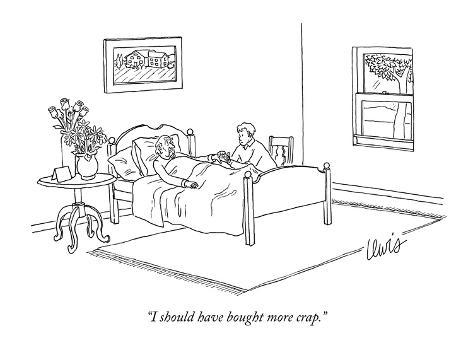
In an earlier post, I discussed the economics of empathy.  That post pertained to both empathy and thanksgiving.  I recently ran across this New Yorker cartoon, which summarizes much positive psychological research into acquiring happiness.


Of course, this cartoon is funny because it is ironic.  If you find it humorous, you know that it is not true:  A man lying on his deathbed and reflecting about meaning in his life does not say, "I should have bought more crap."

"Crap" of course provides an assessment of the ultimate value of possessions.  It is telling, is it not, that we use the term "crap" as a synonym for "material possessions," and yet our culture remains nevertheless consumed with consuming material possessions.

But if happiness and meaning and satisfaction in life does not come by your buying more "crap," in what does it consist? Whence does it derive?

Cornell University psychologist Tom Gilovich, among others, suggests that, instead of consumption, instead of acquiring more things, we do better by acquiring more experiences.

Experiential "consumption" is more enduring.  People tend to talk about their experiences more than their possessions.  This in itself helps experiences to be means of social connections beyond the immediate circle of original participants.  You can extend your experiences, enjoying them again with others or finding empathy from others when they were not so good. Or you can even laugh (after enough time has elapsed) about how awful those experiences were!

Herein lies the enduring value of experiences:  you get to experience them, remember them, and to share them.

Your experiences affect and constitute who you are and who you are in relation to others.

Such sharing fosters empathy, both cognitive empathy ("I know what you mean!") and affective empathy ("I feel how you must have felt!").  It promotes bonding and greater awareness of shared humanity with expanding circles of solidarity. Tom Gilovich's research even suggests that people enjoy each other personally more when they talk about their experiences more than when they talk about their possessions.  So there may be cultivated not only cognitive and affective empathy but also deeper relational affection itself.

Sharing by definition is a form of generosity.  Benevolence is both pro-social and its own reward.

The implication is that, if you are going to try to "buy happiness," purchase an experience, not "more crap."

Tuesday, April 22, 2014

The Loving Tensions of Peter Singer

In reading a conversation between Peter Singer and Alex Voorhoeve, I was struck by a central tension in Prof. Singer's explanation of his ethical views.  It is this.  On the one hand, the Princeton University professor insists that human persons share equal respective value and should be both considered and treated on radically equal terms.  On the other hand, he acknowledges that meaningfulness in human relationships stems from considering and treating human persons on fundamentally different terms. How do we reconcile these ideas and senses?

Thursday, March 6, 2014

DFW and the Fundamental Attribution Error

A couple of weeks ago I decided to revisit David Foster Wallace's famous Kenyon College commencement address from May 21, 2005.  It was subsequently revised and published as "This Is Water."  (The audio and various text editions, including a transcription of the original speech and one cleaned up, are easily available on the web.)  Among many things that struck me upon both rereading and listening to the address, one thing jumped out in particular.  And I think it is one key reason that DFW's address went viral back then and is still discussed now.

Tuesday, September 24, 2013

The Ethical Imagination of Art

Why, when we see acts of apparent selflessness, do we often swell with emotion?

Why, to put an even finer point on this, when we observe even fictional gestures of sincere compassion, do we pause, tear up, reach for a tissue or a nearby loved one, and become seized with something that transcends admiration -- something that feels like melting?

Art, in its various forms, uniquely taps into the human imagination, grips our emotions, and, if we listen, instructs.  Take, for example, the following short video clip, which of late, and deservedly, has been making the social media rounds.

(The YouTube link for the video is here.
The brief article about the video from Gawker is here.)


Wednesday, August 28, 2013

Moral Ambiguities in Prévost, pt. 1: Examples


When we say that someone is a moral example, what exactly do we mean?  How skilled are we at discerning the supposed moral virtue to be emulated?  These are questions that I was prompted to consider recently while reading some European fiction and that I think are of abiding relevance. 

In the Foreward to his delightful novel Manon Lescaut (rev. 1753; orig. 1731), Abbé Prévost describes “the subject of the picture I will present” as “an ambiguous character, a mixture of virtues and vices, a perpetual contrast between good impulses and bad actions.”  Prévost envisions the narrative “as an aid to moral instruction.” Specifically, one “will see, in Des Grieux’s conduct, a terrible example of the power of passions…” (Manon Lescaut, 3, although Prévost’s sincerity here is questionable given the text’s history of censorship).  What remains narratively ambiguous is the nature, or content, of the moral instruction supposedly intended.  Is it traditional or unusual?  Without resolving that question, it seems to me that in seeking empathy from other characters Des Grieux highlights how feelings influence, and usually soften, moral judgment.

Monday, June 3, 2013

Affirming What?

What are the philosophical reasons that support the policy of affirmative action?  And what would admissions letters to students look like if they were philosophically consistent with the supporting rationale?

Thursday, May 16, 2013

Rorty and Kant on Ethics

The shift from the modern to the postmodern is sometimes described in terms of movement away from foundations, away from an anchor for reality, knowledge, and ethics. Richard Rorty diagnoses a sharp contrast between two constellations of moral views, Kantians and Hegelians. In advancing his theory, Rorty sides with the Hegelians against the Kantians: "If the Hegelians are right, then there are no ahistorical criteria for deciding when it is or is not a responsible act to desert a community, any more than for deciding when to change lovers or professions" ("Postmodernist Bourgeois Liberalism," in Pragmatism [ed. Menand], 330). Rorty's framework oversimplifies Kant's moral philosophy on the "ahistorical" matter, but as a heuristic it captures well an impulse -- namely, to derive ethical criteria from the human condition -- that runs from the Enlightenment, including Kant, to Rorty and beyond.

Tuesday, May 14, 2013

Butler and Rousseau on Identity

Discussions, often controversial ones, about same-sex marriage are largely, among other things, about one's gender identity.  And discussions about gender identity can vacillate from the deterministic pole ("I was born this way") to the performative pole ("I construct my own 'gender,' which might differ from my 'sex'").  A recent speech by Lori Watson, Director of the Women's and Gender Studies Program at the University of San Diego, illustrates especially the performative emphasis.  The speech was given in support of the Catholic university's Pride organization student group, which was organizing its 2nd Annual Drag Show.  In thinking about contemporary issues involving gender identity, I returned to the influential theorist Judith Butler.  Her 1990 book Gender Trouble is a seminal study of performativity that is influential in gender/queer circles such as Professor Watson's.

As I began Butler's 2004 book Undoing Gender, in which she clarifies her position on this passive/performative spectrum, I began to wonder about the pedigree of her central theoretical claims.  To what extent does her balancing act now between biological determinism and social construction resemble concerns about identity that also flowered in another era like the Enlightenment?

Although Judith Butler herself would likely not draw connections between her critique of gender and Jean-Jacques Rousseau’s critique of the Enlightenment, some noteworthy echoes (and perhaps unacknowledged debts) exist. In particular, her insistence in Undoing Gender that gender “is a practice of improvisation within a scene of constraint” (p. 1) reflects, despite some important differences, a comparable tension that in his discourses Rousseau argued attended human self-invention in Enlightenment society: enslaving liberation, or alternatively liberated confinement. This similarity between Butler and Rousseau appears in several respects: recognition, the paradox of agency, and (in)authenticity.

Tuesday, April 30, 2013

Mind the Gap

Important mainstream media outlets have consciously decided not to cover the newsworthy trial of Kermit Gosnell, the Philadelphia abortionist accused of killing babies who survived botched terminations.  I previously posted about this trial earlier this month.  To fill in the media coverage gap, let me point to a few pieces that stand out.

Monday, April 29, 2013

Nietzsche and Foucault on Domination

Michel Foucault is justifiably regarded as a Nietzschean thinker.  In Madness and Civilization, Foucault adapts Friedrich Nietzsche’s genealogical method of inquiry and extends Nietzsche’s idea that “in all events a will to power is operating” (“Second Essay:  ‘Guilt,’ ‘Bad Conscience,’ and the Like,” in Genealogy of Morals, 514). Influenced by Nietzsche, Foucault interprets the history of madness in Europe in the 16th and 17th centuries as attempts to control or dominate others, especially when society’s morals are perceived to be violated or threatened. 

Monday, April 15, 2013

Cochrane's Alternative Maximum Tax

Today is the national tax filing deadline, tax day.  And today John H. Cochrane of the University of Chicago wants to start a national conversation about a maximum tax.  I will oblige him to some extent by linking to his blog post, which also appears as an opinion column into today's Wall Street Journal.

Friday, April 12, 2013

An inch of difference?

What difference does an inch make?

That is really the question raised by this USA Today column, "We've Forgotten What Belongs on Page One."

The author writes about the events that form the basis of an ongoing trial in Philadelphia about infanticide performed routinely by a physician. The question surrounds the seemingly artificial, in the author's eyes, distinction between what is moral and what is legal:
...whether [the doctor] was killing the infants one second after they left the womb instead of partially inside or completely inside the womb — as in a routine late-term abortion — is merely a matter of geography. That one is murder and the other is a legal procedure is morally irreconcilable.
So an inch makes the difference between what is illegal and what is legal, between permissible termination of a life and the impermissible termination of it.

The details that emerged during the trial and that are described in the column are just horrifying.  The trial seems to highlight the real dispute at issue:  not when does life begin but when does life become socially valuable?

Our enlightened society and its legal system have an answer. An inch makes all the difference.

Ralph Waldo Emerson is famous for writing in his essay "Self-Reliance" that "[a] foolish consistency is the hobgoblin of little minds, adored by little statesmen and philosophers..."  Apparently, little statesmen are also wont to adore foolish inconsistencies.  And it reflects the smallness of their minds.

Wednesday, April 10, 2013

Hookup Culture and Same-Sex Marriage

A fascinating book review appears in today's Wall Street Journal.  The review is by Emily Esfahani Smith of a new book by Donna Freitas called The End of Sex:  How Hookup Culture Is Leaving a Generation Unhappy, Sexually Unfulfilled, and Confused About Intimacy.

The review includes an interesting suggestion, which I had not seen before but makes perfect sense.  It is that there is a high positive correlation between the increased use of technological devices among youth -- which replaces, removes, or corrupts traditional human interaction (a la Sherry Turkle, Nicholas Carr, and many others) -- and the rise of hookup culture on college campuses. (Previous posts here and here provide a summary of Prof. Turkle's ideas.)

Something else worth pondering is a point that Prof. Freitas makes about the culture of sex on college campuses, here summarized by Ms. Smith:
In other words, many college students, who in philosophy class would surely recognize the ethical imperative not to use other people as means to an end, do so every night in their dorms. This selfishness is why, as Ms. Freitas argues, the hookup culture is intimately related to sexual assault. In both, one person uses another to satisfy a sexual or social desire without any regard for what that other person wants, needs or feels. 
Now, one might counter that the sex is consensual and so there is no assault. But the idea underlying the claim of selfish sexual use that disregards what another person "wants, needs, and feels" goes deeper than this.  It is more holistic.  The assumption seems to be that this sexual activity is done in the absence of thinking about what sex is, what it does relationally, and what it is part of holistically.   And absent these fundamental considerations, hookup sex is personally utilitarian to the extreme and, at bottom, immoral.

Professor Freitas may not go so far as I just put it (i.e., say that hookup sex is immoral), but that is apparently her instinct.  And there is something to that notion.

This discussion of campus sexuality is revealing, it seems to me, for the contours surrounding, and the connections to, the same-sex marriage debate that is now current.  Proponents of same-sex marriage tend to defend it on the basis of a "rights" argument, that it is an individual and civil right to be able to marry whomever one may wish.  But this line of argumentation, while it needs to be considered, may be similar to the hookup sex culture in this way:  it tends to assume something about the fundamental issue of what marriage is, and perhaps like hookup sex culture it misses the point.

Arguing for same-sex marriage may not always include explicitly a definition of what marriage is, but there is certainly an assumed definition, which is really a re-definition.  Redefining marriage from the conjugal view to include same-sex partners turns on the idea that marriage is simply a relationally satisfying forum, one that exists for the pursuit of the happiness, or the fulfillment of desires, of those persons involved.  One full expression of this revisionist view is given by S. Girgis, R. George, and R. Anderson:
Marriage is the union of two people (whether of the same sex or of opposite sexes) who commit to romantically loving and caring for each other and to sharing the burdens and benefits of domestic life. It is essentially a union of hearts and minds, enhanced by whatever forms of sexual intimacy both partners find agreeable. (my emphasis)
What if sexual intimacy according to whatever form that partners find agreeable turns out to be deleterious and misguided, as Prof. Freitas argues about hookup culture?  What if the potential form that sexual intimacy takes in marriage is in fact constitutive of marriage itself properly practiced?

I don't know Prof. Freitas's view of the same-sex marriage question, and I am not suggesting that she would support a conjugal view of it.  Based on the review, I doubt she would.

My main contention is simply that if one is going to discuss the merits or legitimacy of different forms of sexuality -- hookup culture on college campuses and marriage itself (because sexuality has been viewed as intrinsic to marriage) -- one needs to be candid about this:  the fact that the discussion is about, or should really be about, what sex or marriage is most basically.  And everyone in the conversation needs to be willing to engage substantively in that discussion.

The preoccupation with a supposed individual right of same-sex persons to marry obscures the logically prior and necessary question of the basic definition of marriage upon which the exercise of any right depends.  Moreover, if someone is confused about what something is and what it is a part of, as in the case of hookup culture, then the doing of that thing will have deleterious and misguided results.

To adapt the subtitle of Prof. Freitas's book, what if same-sex marriage ends up leaving a generation and its posterity confused about intimacy and what marriage really is?