Recently I posted about medieval Chinese poetry, and I attempted to produce a poem of my own in one particular mode. However successful that endeavor was, it did start me to think about the state of poetry today. In former times, poetry was read, recited, memorized, and exchanged. It formed communal bonds, and it shaped society's worldviews and mores. What is the state of poetry today?
Tuesday, December 16, 2014


Monday, December 8, 2014
New Eyes Seeing: Appreciating Chinese Poetry
The regulated verse that characterized Chinese poetry in the Tang Dynasty (618-907 CE) can be simply elegant in its complexity and complex in its elegant simplicity. I decided to try my hand.

There are at least two basic modes, or forms, of regulated verse.
Mode One
First couplet: introduces time, space, and theme (free)
Second couplet: elaborates theme of the poem (parallel)
Third couplet: turns the theme towards an unexpected direction (parallel)
Fourth couplet: the poet’s resolution or conclusion (free)
Mode Two
First couplet: line one introduces one theme, line two introduces a second theme (free)
Second couplet: elaboration of theme one (parallel)
Third couplet: elaboration of theme two (parallel)
Fourth couplet: tie the two themes together (free)
One of the master poets was Du Fu (712-770 CE). Another was his contemporary, Li Bai (701-762). The following is an example of Du Fu's poetry in mode one, above, of regulated verse.
Minus the alternating tones of the lines, and end rhymes, immediately below is my initial attempt to pay homage at least to the beautiful successes of medieval Chinese verse.
New Eyes Seeing
The wise path has never yet been perfected;
The daughter now for the first time understands.
Phronesis peeks mysteriously from around the fence,
Kongzi wonders curiously even at age seventy.
As the light streams through the window she eyes the diamond's facets,
When darkness descends at sun’s setting the girl perceives the gray shades.
Through his teary eyes the aging man smiles approvingly, knowingly,
Searching still to convey earlier to her what a lifetime only partial gave him.
Friday, December 5, 2014
Lear: The "Abused Nature" "Of This Child-Changed Father"
One of the great pleasures in reading literature is to
discover a few sentences or lines that are so rich with significance that they simultaneously
do two things. On the one hand, they deepen
the narrative, play, or poem as it advances, and, on the other hand, radiate,
and encapsulate, the work’s broader meaning and concerns.
In Shakespeare’s King
Lear, Act 4, scene 7, lines 16-19, Lear’s youngest daughter Cordelia meets
her father and becomes overwhelmed by his state of affairs: his dementia and his abandonment -- more than
that, his abuse and rejection -- by his other two elder daughters Goneril and
Regan. Cordelia interrupts her speech
with an apostrophe to the “kind gods,” and she prays that Lear may be healed.
CORDELIA O,
you kind gods,
Cure this great breach in his abusèd nature!
Th’ untuned and jarring senses, O, wind up,
Of this child-changèd father!
Cure this great breach in his abusèd nature!
Th’ untuned and jarring senses, O, wind up,
Of this child-changèd father!
-- King Lear, IV.vii.16-19
The short passage is pregnant with significance, especially
double meanings.
First, “abused nature”
refers most immediately to his madness (i.e., insanity). Cordelia finds his unmooring from reality to
be particularly pitied. These are his
“untuned and jarring senses.” At the same time, the “abused nature” signifies
the natural relationship of father and daughter that Goneril and Regan have
“abused” in not patiently caring for their aging, ailing father and in their
acute hostility toward him. This is also, as much as the dementia, the “breach”
in his natural constitution: as a person
of sound mind and as a father of (falsely) doting daughters. Ironically, it was Cordelia who in Act 1
affirmed her love for Lear “as are right fit” (1.1.107) and “according to my
[natural filial] bond” (1.1.102), yet whom Lear rejected, abused, by disowning
and banishing from the kingdom.
 |
| "Lear and Cordelia," Ford Madox Brown, 1848 |
Second, the other petition in Cordelia’s prayer is for the
gods to “wind up,” or to mend or fix, the senses (the mental, perceptual, and emotional
capacities) of this “child-changed father.”
The image may be one of a chiming clock, “untuned and jarring,” imprecise
in reflection of reality (as a clock that needs to be wound) and jarring in the
sound it makes as a result of its chiming at the wrong time. Lear himself
variously lashes out and speaks nonsense because of the two factors that so
plague him: his failing mental
capacities and his shattered family relationships with his children. He is, both because of his own banishment of
Cordelia and because of Goneril’s and Regan’s essential “banishment” of him, a
“child-changed father.”
This passage, then, echoes succinctly a key, overarching,
tragic irony of the play. Lear himself, because of his combined natural, hasty,
manic disposition and his increasing dementia, rejects genuine affection where
it was to be found (Cordelia) and is himself rejected by false affection where
he chose, in his foolish pursuit of public professions, to believe it was true
(Goneril and Regan). Cordelia perceives
and feels deeply the tragedy of Lear’s losing himself and his ties to his
daughters, both of which are abuses to his nature.
Friday, October 31, 2014
Dante and Virgil: Learning from Others
To what degree can, or should, we learn from others
different from ourselves? Particularly, how much can, or should, we learn about
the path that we believe we must take from those who have chosen a different
path? This is a question as much about
social relations and integrated thinking as it is about personal identity and
self-discovery.
In Dante’s Inferno, Canto
1, Dante affirms that Virgil is his guide and teacher:
'You are my teacher and my
author.
You are the one from whom alone I
took
the noble style that has brought me
honor.
(Inferno, 1.85-87; all
references to Hollander trans.)
Here Dante refers to his prior poetic writings. The implication is that Dante will also
inform the current poetic enterprise with its subject matter. This is somewhat
curious because also in the first canto we read that Virgil will not be
Dante’s guide in the last stage of his journey upward to
“His city” (l. 126). The reason Virgil
gives is that he is not worthy to guide Dante through paradiso to God,
and the reason for his unworthiness is that Virgil himself strayed from the
righteous path that Dante seeks to find:
'Should you desire to ascend to
these,
you'll find a soul more fit
to lead than I:
I'll leave you in her care
when I depart.
'For the Emperor who has His
seat on high
wills not, because I was a
rebel to His law,
that I should make my way
into His city.
(Inferno, 1.121-126)
Despite Virgil’s spiritual state as a reprobate, as a rebel,
as someone in other words who did not bend his will to God and who did not
follow his righteous path, Virgil himself asserts that he is, however, fit to instruct and lead Dante through hell:
'Therefore, for your sake, I think
it wise
you follow me: I will be your guide
(Inferno, 1.112-13)
Yes, we learn later in the Inferno that God had commissioned Virgil for this task. In Inferno
canto 2, we learn that this commission came through three heavenly ladies, but
the point is that Virgil bears God’s authority when interacting with
inhabitants of hell at various stages.
My own reflections about my current identity development and
self-discovery prompted these thoughts as I recently read Dante’s Inferno:
Virgil the pagan poet is authoritatively permitted, commissioned, to
instruct Dante in his pursuit of light and righteousness. Virgil may have been opposite to God but yet
still may be a reliable guide -- in fact, a heaven-sent guide. The pagan poet acts as pedagogue to the
spiritual pilgrim.
So again, the particular related struggle or question: What and how can I learn about the path I
must take from those who have chosen a different path?
This question strikes me as one of universal concern. It assumes that we are all wrestling with the
question of self, of our own respective identities, while at the same time
locating ourselves in connection with (and distinction from) others, even
others not of our “circle.” Or we are
negotiating ever expanding circles. What
is the proper relationship? How close is
too close? Will I be influenced overly
by their decisions rather than finding the proper balance between their ideas
and my own?
 |
| Dante and Virgil, rendered by Botticelli |
In my own life, I am currently near that midpoint, just as
Dante was, the nel mezzo. I am trying to ask from familiar and
unfamiliar points of view big questions about God (nature, revealed truth), about
God’s relations to humans (of what sort is it?), about human nature and the
relation of the mind to both the brain (is there really anything that is a “mind”?
Is it somehow distinct from the physical brain and chemical reactions?), and about
the nature of morality in general and its relationship to God in particular
(what is the precise connection? Is there a necessary foundation?).
In asking these and other questions, I find that I must
necessarily do at least two things. (1) I must reevaluate what I believe by
taking stock first of what I actually think (perhaps with greater precision
than I hitherto have or have in some while, a valuable enterprise itself). And (2) I must weigh that review against the
ideas of others who have followed paths that I have not before trodden. Is it
better? If not, why is it worse? What to pursue, what to avoid? What to retain, what to reject?
Of late in my own life have been wondering how modern
neuroscientific conceptions of the brain bear on questions of human sinfulness,
ethical behavior and responsibility, and the need for salvation at all. Physiologically,
what goes into cognition and moral judgment?
What implications might there be, if any, on various religious belief if
philosophical and psychological theories about the modular mind and the lack of
anything like a singular “self” prove to be true? What of the question of chemical explanations
for innate ideas of transcendence and the divine?
The upshot, and the connection between Dante’s poem and my
own external context (and perhaps one of universal concern) is the extent to
which I can learn from guides or teachers not within my circle and yet continue
to follow the righteous, God-approved path.
Dante altered his path, and in so doing also altered his conception of
himself -- at least expanding it. For
Dante in the dark wood of the mid point of his life, it was not a matter of
interacting with things like ancient Chinese thought or neuroscience. But on his path he was surprised to find
Virgil as his guide through the Inferno,
a guide limited to a portion of the journey, but reliable nevertheless and
divinely commissioned however different from Dante he may have been. But Dante the poet was also relieved and
encouraged to find his guide to be Virgil, the Roman poet par excellence. And it may be that certain connections are
more important than differences to initiate our exploration of both.
How may I learn from Virgil without befalling his fate? That is perhaps one of Dante’s questions, and it is,
metaphorically, mine and, in one way or another, also all of ours.
Thursday, October 30, 2014
Dante at the end of Vita Nuova
I have recently been digging into Dante, which, I am ashamed
to say, I have never really explored previously. I started with Inferno, and then returned to an earlier work, La Vita Nuova (“The New Life”).
A question that is preoccupying me is the extent to which Dante develops
the idea of the self in his poetry.
 |
| Dante encountering Beatrice |
This is a notion that one might read consistent with the
Catholic western tradition of Augustine of Hippo’s Confessions. This is a
religious meditation that has, among other things, as its effect the production
of religious autobiography for spiritually edifying purposes, both within
oneself and within others. On the other
hand, there can be a tendency to read Dante, and particularly the Commedia with such a concern for “self-actualization”
or “self-discovery” that it seems like Dante’s concern is more naturally at
home in the Enlightenment or later French existentialism than in Renaissance
Italy. About this I am suspicious, but
still undecided.
At the end of Vita
Nuova, which preceded the publication of The Divine Comedy by at least 13 years, what portrait of Dante
emerges? What do we learn about the pre-Inferno Dante?
We glimpse in the Vita
Nuova a poet who, on the one hand, is still enamored of Beatrice as he was
at the beginning of his prosimetrum
work of courtly love, but who, on the other hand, seems confused about her and
his relationship to her. Indeed, he
seems confused about himself.
In chapter 42 we read of his fixation and vision; we also
read of his uncertainty how to describe or to understand this view of Beatrice:
After I wrote this sonnet there came to me a miraculous vision
in which I saw things that made me resolve to say no more about this blessed
one until I would be capable of writing about her in a nobler way. To achieve
this I am striving as hard as I can, and this she truly knows. Accordingly, if
it be the pleasure of Him through whom all things live that my life continue
for a few more years, I hope to write of her that which has never been written
of any other woman.
Not only does Dante seem to believe that the late Beatrice
still has consciousness (“and this she truly knows” -- present tense). He
also seems to reflect either his own poetic incapacity at present to write of
her or his uncertainty about what it all means:
“until I would be capable of writing about her in a nobler way.” Does “in a nobler way” mean his poetic
technique? Or does it refer to his own
disposition and needing to mature in his feelings and expression beyond the raw
and still searching emotions that he has now?
Or both?
When he does write about her again later in the Commedia, will she still be the object
of his desire? Or will his desires have changed, his preoccupations?
It may be, as it seems to me, that in both the Vita Nuova and the later Commedia, in their own respective ways, Beatrice
serves the purpose of helping Dante to give voice to his own misgivings about
his life and its proper direction.
At the end of Vita Nuova, in any event, Dante still
seems to be searching for himself and his voice. In other words, he seems to be searching for
a beginning, a new life of poetic and self expression.
Tuesday, October 28, 2014
The Economy and Pursuit of Happiness
In an earlier post, I discussed the economics of empathy. That post pertained to both empathy and thanksgiving. I recently ran across this New Yorker cartoon, which summarizes much positive psychological research into acquiring happiness.

Of course, this cartoon is funny because it is ironic. If you find it humorous, you know that it is not true: A man lying on his deathbed and reflecting about meaning in his life does not say, "I should have bought more crap."
"Crap" of course provides an assessment of the ultimate value of possessions. It is telling, is it not, that we use the term "crap" as a synonym for "material possessions," and yet our culture remains nevertheless consumed with consuming material possessions.
But if happiness and meaning and satisfaction in life does not come by your buying more "crap," in what does it consist? Whence does it derive?
Cornell University psychologist Tom Gilovich, among others, suggests that, instead of consumption, instead of acquiring more things, we do better by acquiring more experiences.
Experiential "consumption" is more enduring. People tend to talk about their experiences more than their possessions. This in itself helps experiences to be means of social connections beyond the immediate circle of original participants. You can extend your experiences, enjoying them again with others or finding empathy from others when they were not so good. Or you can even laugh (after enough time has elapsed) about how awful those experiences were!
Herein lies the enduring value of experiences: you get to experience them, remember them, and to share them.
Your experiences affect and constitute who you are and who you are in relation to others.
Such sharing fosters empathy, both cognitive empathy ("I know what you mean!") and affective empathy ("I feel how you must have felt!"). It promotes bonding and greater awareness of shared humanity with expanding circles of solidarity. Tom Gilovich's research even suggests that people enjoy each other personally more when they talk about their experiences more than when they talk about their possessions. So there may be cultivated not only cognitive and affective empathy but also deeper relational affection itself.
Sharing by definition is a form of generosity. Benevolence is both pro-social and its own reward.
The implication is that, if you are going to try to "buy happiness," purchase an experience, not "more crap."
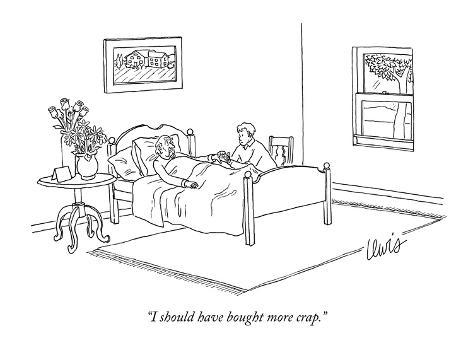
Of course, this cartoon is funny because it is ironic. If you find it humorous, you know that it is not true: A man lying on his deathbed and reflecting about meaning in his life does not say, "I should have bought more crap."
"Crap" of course provides an assessment of the ultimate value of possessions. It is telling, is it not, that we use the term "crap" as a synonym for "material possessions," and yet our culture remains nevertheless consumed with consuming material possessions.
But if happiness and meaning and satisfaction in life does not come by your buying more "crap," in what does it consist? Whence does it derive?
Cornell University psychologist Tom Gilovich, among others, suggests that, instead of consumption, instead of acquiring more things, we do better by acquiring more experiences.
Experiential "consumption" is more enduring. People tend to talk about their experiences more than their possessions. This in itself helps experiences to be means of social connections beyond the immediate circle of original participants. You can extend your experiences, enjoying them again with others or finding empathy from others when they were not so good. Or you can even laugh (after enough time has elapsed) about how awful those experiences were!
Herein lies the enduring value of experiences: you get to experience them, remember them, and to share them.
Your experiences affect and constitute who you are and who you are in relation to others.
Such sharing fosters empathy, both cognitive empathy ("I know what you mean!") and affective empathy ("I feel how you must have felt!"). It promotes bonding and greater awareness of shared humanity with expanding circles of solidarity. Tom Gilovich's research even suggests that people enjoy each other personally more when they talk about their experiences more than when they talk about their possessions. So there may be cultivated not only cognitive and affective empathy but also deeper relational affection itself.
Sharing by definition is a form of generosity. Benevolence is both pro-social and its own reward.
The implication is that, if you are going to try to "buy happiness," purchase an experience, not "more crap."
Wednesday, October 8, 2014
Some Reflections on "Things" (by Borges)
In his poem “Things,” Jorge Luis Borges explores, really almost just catalogues, everyday things with daring flatness. There is perhaps an apparent irreverence for the grandiose subjects of much poetry. Or so it could seem. Yet this irreverence and the daring flatness have an edge. What emerges from the poetic images is a deeper philosophical reflection on passing moments of the everyday in a sea of eternity. This complex collage itself reflects Borges’s deep concern with questions of time and human temporality.
Subscribe to:
Posts (Atom)